Table of Contents
Introduction: A Rejection Isn’t the Final Word
Receiving a rejection notice from SASSA (the South African Social Security Agency) can feel like a devastating blow. You’ve waited, you’ve hoped, and now you’re left with a notification that says “Application Declined.” It’s frustrating, confusing, and for many, it adds a heavy weight of financial uncertainty. We want you to know this feeling is valid, and you are not alone. Thousands of South Africans face this same challenge every month.
But here is the most important thing to remember: a rejection is not the end of the road. It is simply the start of a new process—the appeal. You have the legal right, under the Social Assistance Act, 2004, to challenge this decision and have your case re-examined. Winning an appeal is not about luck; it’s about understanding the system, knowing your rights, and preparing a strong, evidence-based case.
This guide is your comprehensive playbook. We’ve combined legal expertise with simple, step-by-step instructions to demystify the SASSA grant appeal process. Whether you’ve been declined for the SRD R370 grant, a Disability Grant, or a Child Support Grant, we will walk you through every stage. We’ll help you diagnose why you were rejected, show you exactly how to submit your appeal, provide checklists for your evidence, and share success stories from people just like you.
Consider this your personal legal specialist, here to empower you with the knowledge to turn that “Declined” status into “Approved.”
Why Was Your Grant Rejected? Understanding the 5 Common Reasons
Before you can fight a rejection, you must understand it. Your rejection notice from SASSA isn’t just a “no”; it contains the specific reason for their decision. This reason is the key to your entire appeal strategy. Let’s break down the five most common reasons for rejection and what they actually mean.
1. “Income Source Identified” or Means-Test Failure
This is, by far, the most frequent reason for rejection, especially for the SRD R370 grant. SASSA uses automated systems to check your ID number against various government and private databases, including bank records, to see if you are receiving any income.
- What it means: The system has flagged money coming into your bank account that exceeds the grant’s income threshold. For the SRD grant, this threshold is very low. Even small, irregular payments from family members, side-jobs, or other sources can trigger a rejection.
- How it happens:
- Bank Verification: SASSA’s system detects deposits into your bank account. It doesn’t always distinguish between a salary and a family member sending you R600 for groceries.
- UIF Registration: Your ID might still be linked to a previous employer’s UIF database, even if you are no longer working there.
- Other Financial Products: An investment or savings account you forgot about could be generating small amounts of interest, flagging you in the system.
- What you need to do: Your appeal must prove that this flagged income is not a regular salary or that it falls below the required threshold. Bank statements are your most powerful tool here.
2. Incomplete or Incorrect Documentation
Simple paperwork errors are a heartbreaking reason to be denied essential support. This happens when the information you provided is missing, doesn’t match official records, or was not submitted correctly.
- What it means: SASSA could not process your application because a crucial piece of information was either wrong or absent.
- Common examples:
- ID Verification Failed: The name, surname, or ID number you provided does not perfectly match the Department of Home Affairs records.
- Invalid Medical Assessment: For a Disability Grant, the doctor’s report may be older than three months, or the assessment might not be detailed enough about how your disability prevents you from working.
- Missing Proof of Schooling: For a Child Support Grant for an older child, you may not have included a letter from the school.
- Incorrect Banking Details: A single wrong digit in your account number can lead to rejection.
- What you need to do: Your appeal must focus on providing the correct, complete, and up-to-date documentation.
3. “Existing SASSA Grant” or Duplicate Application
The system is designed to prevent individuals from receiving multiple social grants that are not permitted to be held concurrently.
- What it means: SASSA’s records show you are already an active beneficiary of another social grant (like the Old Age Pension or Disability Grant), which often makes you ineligible for others, like the SRD grant. Alternatively, you may have submitted your application more than once, confusing the system.
- How it happens:
- You are legitimately receiving another grant.
- You applied for the same grant multiple times, creating duplicate entries.
- Someone else may have fraudulently used your details to apply for a grant.
- What you need to do: If you are not receiving another grant, your appeal must clarify this. If fraud is suspected, it must be reported immediately.
4. Missed Appointments or Biometric Failures
For certain grants, particularly the Disability Grant, your physical presence is required for verification or assessment.
- What it means: You were scheduled for a medical assessment or a biometric verification appointment at a SASSA office but did not attend.
- Why it’s critical: The medical assessment is the core evidence for a Disability Grant. Missing it leads to an automatic rejection because SASSA has no proof of the disability’s severity. Biometric checks are used to prevent fraud and confirm you are who you say you are.
- What you need to do: If you had a legitimate reason for missing the appointment (e.g., you were sick, had a family emergency), your appeal must include proof of this reason and a request to be rescheduled.
5. Fraud Flags and System Glitches
Sometimes, the rejection has nothing to do with your eligibility but is caused by a system error or a fraud alert on your profile.
- What it means: The system has detected suspicious activity linked to your ID number or phone number, or there was a technical glitch during processing.
- How it happens:
- Your mobile number might be linked to multiple grant applications.
- Your ID number might have been used in a previously flagged fraudulent application without your knowledge.
- A simple system error might have incorrectly categorised your application.
- What you need to do: This is often the hardest reason to prove. Your appeal should state clearly that you believe the rejection is an error and request a manual review of your file.
The SASSA Appeal Master Timeline
Navigating the appeal process can feel slow and uncertain. Knowing the key deadlines and average waiting times helps you stay in control. Remember, there are two distinct paths: one for the SRD R370 grant and another for all other grant types.
| Stage | For SRD R370 Grant | For Other Grants (Disability, Old Age, etc.) |
|---|---|---|
| 1. Rejection Notification | You check your status online and see “Declined” for a specific month. | You receive a formal rejection letter via post or from the SASSA office. |
| 2. Deadline to Appeal | Crucial: You have 90 days (3 months) from the end of each declined month to appeal, as set out by ITSAA. | You have 90 days from the date you received the rejection letter to lodge a reconsideration, per SASSA Form 1. |
| 3. Lodging the Appeal | Online only: Submit via the ITSAA SRD Appeals website. | In-person or post: Submit a completed Form 1 at your nearest SASSA office with all supporting documents. |
| 4. Average Waiting for Outcome | 60 to 90 days. ITSAA reviews your case and updates the portal once a decision is made. | Up to 90 days. A different SASSA official reconsiders your application using the new evidence. |
| 5. Receiving the Decision | Decision is communicated electronically—log back into the appeals website to see “Approved” or “Declined.” | You will receive a formal letter with the outcome of the reconsideration. |
| 6. What If You’re Rejected Again? | The ITSAA decision is usually final for SRD appeals; the next escalation would be a High Court review. | You have another 90 days to appeal to the Minister of Social Development in writing, following the DSD appeal guidance. |
Your Step-by-Step Appeal Playbook
Now it’s time for action. This section provides a detailed, step-by-step guide to lodging your appeal. Follow the instructions for your specific grant type carefully.
How to Appeal the SRD R370 Grant
The SRD grant appeal is handled by an independent body called the Independent Tribunal for Social Assistance Appeals (ITSAA). The entire process is digital.
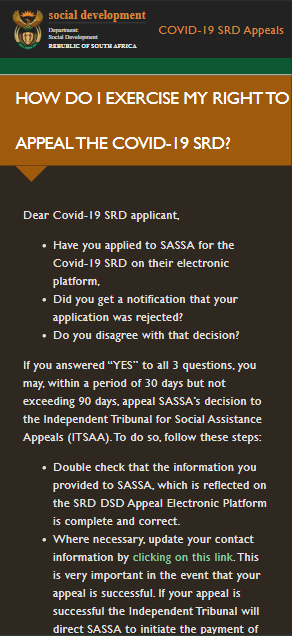
Step 1: Gather Your Information You will only need two things to start:
- Your 13-digit South African ID number.
- The mobile phone number you used in your original application.
Step 2: Go to the Official SRD Appeal Website Do not use any other website. The only official portal is: https://srd.sassa.gov.za/appeals. Bookmark this page.
Step 3: Initiate Your Appeal
- On the website, you will see fields to enter your ID number and phone number.
- Enter the details and click “Send Pin.” An SMS with a One-Time Pin (OTP) will be sent to your phone.
- Enter the pin to securely log in.
Step 4: Select the Month(s) to Appeal
- This is the most critical part of the SRD appeal. You must appeal for each and every month that you were declined.
- The website will show a list of months with a “Declined” status.
- Select the month you wish to appeal and click “Submit Appeal.” You will need to repeat this for every month you disagree with. For example, if you were declined for May and June, you must submit two separate appeals.
Step 5: Provide a Reason (If prompted) The system may ask you to select a reason for your appeal. Choose the one that best matches your situation. If your rejection was due to “income source identified,” but you have no income, you can state this. The system is primarily based on re-checking your details against databases, so a detailed written reason is often not required, but if the option is there, use it.
Step 6: Track Your Appeal Status ITSAA usually takes 60 to 90 days to process an appeal. You will not receive an SMS with the outcome. You must proactively check your status by logging back into the same appeals website. The status will change from “Pending” to “Approved” or “Declined.”
How to Appeal Other SASSA Grants (Old Age, Disability, Child Support, etc.)
This process is more traditional and paper-based. It starts with an internal SASSA process called “reconsideration.”
Step 1: Get the Rejection Letter in Writing SASSA must provide you with a written notice explaining why your application was declined. Do not leave the SASSA office without this letter. It is your legal right to have it, and it forms the basis of your appeal.
Step 2: Obtain the Correct Appeal Form You need to complete Form 1 - Lodging of an Appeal Form (available from SASSA offices or as a PDF download). Do not use any other form.
Step 3: Complete the Appeal Form Carefully
- Section A: Fill in your personal details exactly as they appear on your ID.
- Section B: This is the most important part. You must clearly state the reasons why you disagree with SASSA’s decision.
- Refer directly to the reason given in your rejection letter.
- Example: “SASSA’s letter states my application was declined due to ‘income source identified.’ This is incorrect. The money in my account was a once-off gift from my son to help with funeral costs, not a regular income. I have attached an affidavit and bank statements to prove this.”
- Be factual, polite, and to the point.
Step 4: Gather Your Supporting Evidence This is where you prove your case. You must provide evidence that directly contradicts the reason for rejection. See the checklist in the next section for a full breakdown.
Step 5: Submit Your Appeal within 90 Days Take your completed appeal form and all your supporting documents to your nearest SASSA office.
- Submit it to an official and ask them to sign and stamp a copy of your form as proof of submission. This is your receipt. Do not lose it.
- The 90-day deadline is strict. If you are late, you must also complete Form 2 - Application for Condonation for Late Appeal and provide a compelling explanation for the delay.
Step 6: Wait for the Reconsideration Outcome SASSA will take up to 90 days to review your appeal. An official who was not involved in the first decision will re-examine your entire application with the new evidence you’ve provided. You will receive a letter informing you of the outcome.
Step 7: If Unsuccessful, Appeal to the Minister If the internal reconsideration is also unsuccessful, you have one final step. You have another 90 days to write a letter of appeal directly to the Minister of Social Development, following the process described by the Department of Social Development. Your letter should explain why you disagree with both the original decision and the reconsideration outcome. This process can be complex, and seeking help from a legal aid organization is highly recommended at this stage.
For comprehensive legal assistance, visit our Legal Aid Resources page which includes detailed contact information for Legal Aid South Africa (toll‑free 0800 110 110, Please Call Me 079 835 7179), university law clinics, community advice offices, and other free legal support services available in your province.
Your Evidence & Documents Checklist
A successful appeal is built on strong evidence. Use the interactive checklist below to track your progress. A floating progress widget will appear as you scroll to help you keep track without losing your place.
Interactive Document Checklist
Documents every appellant should keep ready
- Your 13-digit South African ID (certified if possible).
- Proof of address from the last three months.
- The official rejection letter or status screenshot showing the decline reason.
- A dated note of when you received the decision and your 90-day deadline.
- Proof of submission once you hand in or upload your appeal.
SRD R370 appeals: add these first
- Log in to the ITSAA appeal portal and list each declined month you want reviewed.
- Confirm the cellphone number on your SRD profile can receive OTP messages.
- Download a fresh PDF or screenshot of the reason shown for each declined month.
SRD: “Income source identified” or UIF matches
- Print 3–6 months of bank statements that show the irregular or once-off payments.
- Draft an affidavit explaining who sent the money and why it is not income.
- Ask a former employer to confirm in writing that you are not earning wages or UIF.
SRD: identity or contact mismatch
- Update your personal details (ID, name, number) on the SRD portal before you appeal.
- Keep screenshots proving the update succeeded in case the issue repeats.
- Prepare a certified copy of your ID to upload if the portal prompts you.
Permanent grants: core paperwork (Old Age, Disability, Child Support, etc.)
- Collect Form 1 – Lodging of an Appeal – and complete every field in black ink.
- Attach certified copies of IDs for you and any dependants on the application.
- Bundle proof of income or lack of income for your household (payslips, bank slips, affidavits).
Permanent grants: missed appointment or medical issues
- Gather proof of the reason you missed the assessment (doctor’s letter, hospital card, police case number).
- Write a short letter asking to be rebooked and include alternative contact details.
- For Disability Grant reviews, request a new medical assessment dated within the last three months.
Permanent grants: documentation or foster care gaps
- Renew or replace any expired court orders, guardianship letters, or school confirmations.
- Re-certify birth certificates, IDs, or marriage certificates that SASSA previously rejected.
- Add a covering note that lists each document you corrected so the new reviewer can tick them off quickly.
SASSA Income Eligibility Calculator (2024/25)
Check if your monthly income qualifies you for SASSA grants. This calculator uses the official 2024/25 income thresholds to determine your eligibility based on grant type and marital status.
Common Mistakes & How to Avoid Them
Many appeals fail not because the person is ineligible, but because of simple, avoidable mistakes. Learn from them to make sure your appeal is as strong as possible.
| The Mistake | How to Avoid It |
|---|---|
| 1. Missing the Deadline | The 90-day deadline is non-negotiable. Mark the date on a calendar. Lodge your appeal as soon as you have your documents ready. Don’t wait until the last week. |
| 2. Submitting an Incomplete Form | Read every question on the appeal form carefully. Answer everything. If a question doesn’t apply, write “N/A”. An empty field can be grounds for rejection. Get someone to double-check it for you. |
| 3. Not Providing Enough Evidence | Don’t just say SASSA is wrong; prove it. If they say you have income, provide bank statements and an affidavit to show the source. If they say your medical form is old, provide a new one. |
| 4. Using the Wrong Appeal Channel | SRD R370 appeals are online only. Do not go to a SASSA office. Other grant appeals are paper-based only. Do not try to appeal via email or the website. Using the wrong channel means your appeal won’t be seen. |
| 5. Not Keeping Copies of Everything | Before you submit anything, make copies for yourself. Take a picture on your phone if you have to. This includes your appeal form, all your evidence, and especially the stamped receipt from SASSA. |
| 6. Being Rude or Aggressive | We know you’re frustrated, but being polite and professional in your written appeal and in person will always work in your favour. Stick to the facts of your case. |
Case Studies: Real Stories of Winning Appeals
These stories show how ordinary South Africans, faced with a rejection, used the right strategy to win their appeals.
Case Study 1: Gogo Thandi and the “Income” That Wasn’t
- Background: Gogo Thandi, 72, was rejected for her Old Age Grant. The reason was “income means-test failure.” She was confused as her only money came from her children, well below the grant threshold.
- The Problem: Her children sent her money for groceries via e-wallet, which she then deposited into her bank account. SASSA’s system flagged these deposits as regular income.
- Action Taken: With her granddaughter’s help, she got 6 months of bank statements. They submitted an appeal with an affidavit explaining that the deposits were inconsistent financial support from family, not a salary. The bank statements clearly showed the irregular nature of the small deposits.
- Outcome: Her appeal was approved after two months. The evidence proved the money was not formal income, and she was granted her pension, backdated to her original application.
- Key Takeaway: Always explain the source of money in your account. An affidavit is a powerful tool to give context to your bank statements.
Case Study 2: Sipho’s SRD R370 Identity Glitch
- Background: Sipho, an unemployed 28-year-old, saw his SRD R370 application for July declined for “Identity Verification Failed.” He had recently gotten a new phone and number.
- The Problem: The system couldn’t match his application to his identity, likely because his old phone number was still on SASSA’s database, creating a mismatch for the security OTP.
- Action Taken: First, Sipho went to the SRD website and updated his contact details to his new number. Then, he logged onto the official appeals portal and lodged an appeal specifically for July. He didn’t need to add much detail, as the act of appealing triggers a new verification check.
- Outcome: 65 days later, he checked the appeals portal again. The status for July had changed to “Approved.”
- Key Takeaway: Keep your personal details, especially your mobile number, updated with SASSA. For SRD appeals, persistence and using the correct online portal is key.
Case Study 3: Lerato’s Disability Grant and the Outdated Form
- Background: Lerato applied for a Disability Grant due to severe arthritis that prevented her from working. Her application was rejected for “insufficient medical information.”
- The Problem: The medical assessment she submitted was from a doctor’s visit four months prior. SASSA rules state the form cannot be older than three months at the time of application.
- Action Taken: Lerato booked a new appointment with her doctor immediately. She got a new, comprehensively filled-out medical assessment form. She then submitted her appeal at a SASSA office with the new form attached to her appeal letter, which explained she was now providing the up-to-date assessment as required.
- Outcome: Her reconsideration was successful. The new medical report provided the current evidence SASSA needed to approve her grant.
- Key Takeaway: Pay close attention to dates and validity periods on official documents. A simple error like an old form is an easy fix for an appeal.
Frequently Asked Questions (FAQ)
How much does it cost to appeal a SASSA grant?
Can I get help to fill out my SASSA appeal form?
What happens if I miss the 90-day appeal deadline?
Do I have to re-apply if my appeal is rejected?
How do I check my SASSA appeal status?
Will I get paid for the months I was waiting for my appeal?
What can I do if my appeal to the Minister is also rejected?
Can I submit my appeal via email?
Get More Help & Stay Updated
The world of SASSA grants can change. Rules are updated, and new information becomes available. Staying informed is your best strategy for success.
Subscribe to Our Newsletter Get the latest news on grant payment dates, policy changes, and appeal tips delivered straight to your inbox.
Conclusion: You Have the Power to Challenge the Decision
We began this guide by telling you that a rejection is not the final word, and we hope you now truly believe it. The SASSA appeal process exists for a reason: to ensure that every applicant gets a fair chance. It’s a system of checks and balances designed to correct errors and reconsider individual circumstances.
The path may seem slow and bureaucratic, but it is a path you can walk successfully. By understanding why you were rejected, meticulously preparing your evidence, and following the correct procedures, you shift the odds dramatically in your favour.
Your immediate next steps are clear:
- Find your rejection letter or check your online status to pinpoint the exact reason for the decline.
- Use our checklists to gather the specific documents you need to prove your case.
- Mark the 90-day deadline on your calendar and start working on your submission today.
You have the right to this support, and you have the power to fight for it. Be patient, be persistent, and be prepared. You can do this.
References
- Social Assistance Act, 2004 (Act No. 13 of 2004)
- Independent Tribunal for Social Assistance Appeals (ITSAA)
- SASSA Form 1: Lodging of an Appeal
- Application for Condonation for Late Appeal (Form 2)
- Department of Social Development: Social Grant Appeal Process
- Child Support Grant overview (gov.za)
- SASSA statement: Disability grant applicants have a right to appeal
Read Next
SASSA SRD R370 Grant Appeal Process: Complete Guide
SASSA SRD R370 Grant Appeal Process: Complete Guide
If your SASSA Social Relief …
Comments & Discussions