
Table of Contents
Title: The R99 Debit Order Plague: Is a Funeral Policy Silently Stealing 25% of Your R390 SASSA Grant in 2026?
If you’re relying on a SASSA grant to survive in 2026, you need to check your bank statement right now. I’m seeing a disgusting trend where funeral policy sharks are literally waiting at the till to snatch 25% of your R390 payment before you even leave the store. This guide breaks down how this R99 scam works and how you can fight back.
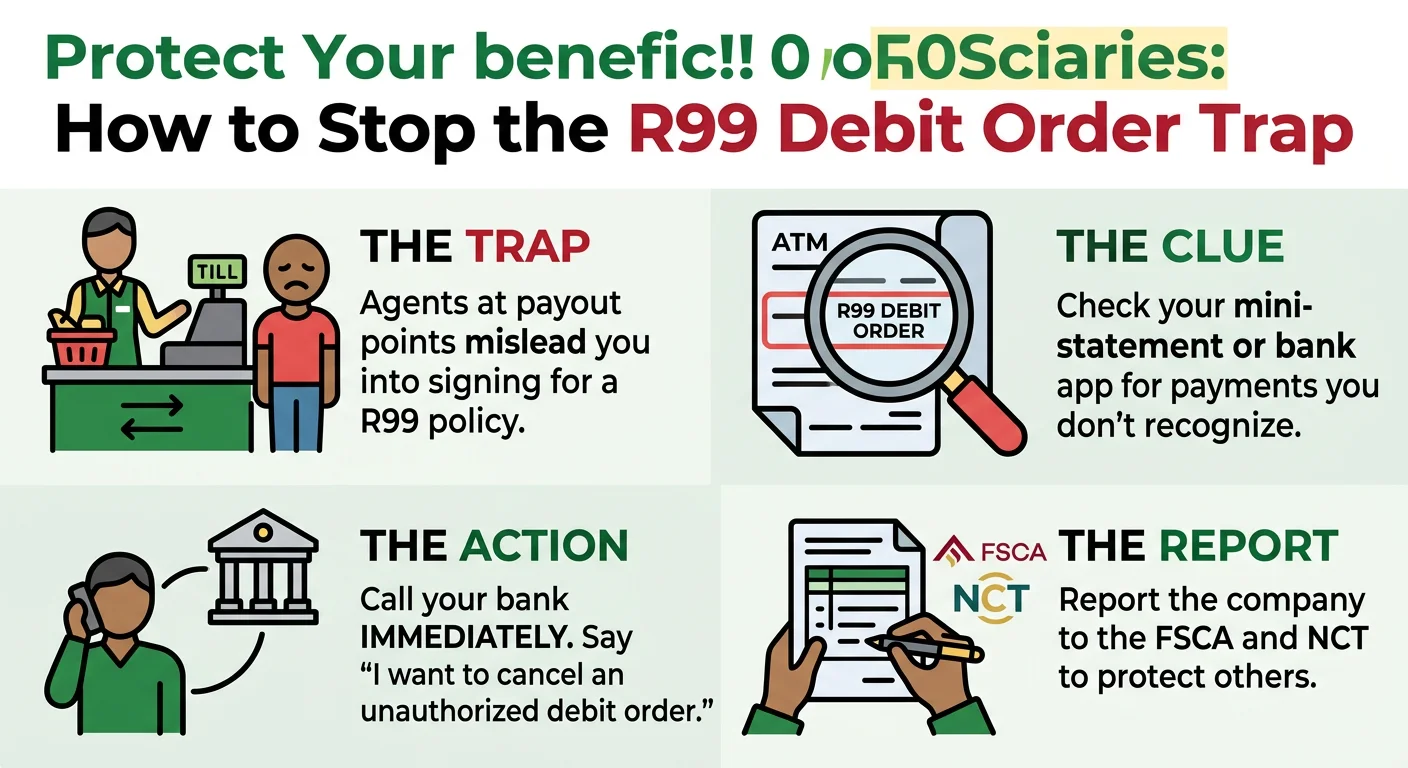
The R99 ‘Till-Point Trap’: A National Crisis Targeting SASSA Beneficiaries in 2026
A new financial plague is sweeping across South Africa this March 2026. It’s happening in the one place where grant recipients should feel safe: the retail payout point. I’ve been following reports from consumer watchdogs, and the news is grim. There is a massive surge in complaints against insurance agents lurking near the tills at major supermarkets like Shoprite, Checkers, and Pick n Pay.
These agents use high-pressure tactics to sign people up for R99-per-month funeral policies. Often, they don’t even tell you what you’re actually signing. The Financial Sector Conduct Authority (FSCA) put out a warning in early March 2026 about these “unscrupulous practices” targeting the most vulnerable people in our communities. The National Consumer Tribunal (NCT) says disputes over unauthorized debit orders on SASSA-linked accounts have jumped by 40% since the start of the year. If you’re living on the R390 SRD grant, losing R99 isn’t just an “inconvenience.” It’s a disaster. That’s 25% of your survival money gone in an instant.
How They Trap You: The Deceptive Tactics of Payout Point Predators
The success of this scheme relies on pure deception. Agents are trained to catch you when you’re distracted, like when you’re busy packing groceries or counting your change. They don’t ask if you want insurance. Instead, they lie. They call the policy a “SASSA Account Protection Plan” or a “free loyalty benefit” that you just need to “activate.”
Here is how the trap usually snaps shut:
- The Ambush: A friendly, well-dressed agent stops you just as you finish your transaction.
- The Misleading Pitch: They use confusing terms like “SASSA compliance” to make it sound like the government requires this. They never start by saying they are selling insurance.
- The Digital Consent: They hand you a tablet or a digital pad. They tell you it’s just to “verify your grant payment.” What they don’t tell you is that you’re actually signing a DebiCheck mandate.
- The SMS Trick: When your bank sends an authentication SMS, the agent tells you to “approve it quickly so your funds can be released.” In reality, you just gave them permission to take your money every single month.
Thando Mkhize from the People’s Finance Initiative is right when she calls this “systemic financial abuse.” It makes me angry to see people exploited this way. For many, that R99 is the difference between having transport to a clinic or buying bread for the last week of the month.
The Devastating Impact: How R99 Becomes a R1,188 Annual Burden
The true cost of these predatory debit orders is much higher than it looks on paper. For a person on the R390 SRD grant, this deduction pushes them way below the food poverty line. Stats SA recently put that line at R760 per month in their 2026 report.
Let’s look at the actual damage:
- Monthly Loss: R99 is 25.4% of your R390 grant. That’s money meant for maize meal, oil, or electricity.
- Annual Drain: Over a year, you lose R1,188. That is more than three full months of the SRD grant stolen from you.
- The Debt Cycle: When that R99 goes missing, people often have to go to loan sharks just to eat. It creates a hole that is almost impossible to climb out of. Worst of all, many of these policies have so many “fine print” exclusions that they probably won’t even pay out when your family needs it.
Are You a Victim? Your 3-Step Guide to Investigating Your SASSA Account
I’ve spoken to many people who didn’t even realize money was being taken until their balance hit zero earlier than expected. You have to be proactive. Here is how you check your account right now:
- Get a Mini-Statement: Go to any ATM and put in your card. Select “Mini Statement.” This slip shows your last few transactions. Look for any weird payments for R99, R110, or R150.
- Use Your Banking App or USSD: If you have a banking app, check your history there. If not, use USSD. For Capitec, dial
*120*3279#. For other services, you might use*134*7737#or your bank’s specific code. Always make sure you are using the official number. - Request a Full Bank Statement: If you’re suspicious, go into the bank and ask for a 3-month statement. It might cost a few Rand, but it’s worth it. Look at every single line. If you see a company name you don’t recognize, they are stealing from you.
Fighting Back: How to Cancel Predatory Debit Orders in 2026
If you find one of these unauthorized deductions, don’t panic, but act fast. You have the power to stop them.
- Step 1: Talk to your bank immediately. Go to a branch or call them. Tell them: “I want to dispute and cancel an unauthorized debit order.” They have to help you. If the payment happened in the last 40 days, they can often reverse it and get your money back.
- Step 2: Put a Stop Payment in place. Ask the bank to block that specific company from ever taking money again. There might be a small fee, but it stops the bleeding.
- Step 3: Report the predators. We need to stop them from doing this to others. File a complaint with the FSCA (they handle the insurance side) or the National Consumer Tribunal (NCT) if you were lied to.
- Step 4: Keep your paperwork. Write down who you spoke to at the bank and save any reference numbers. You’ll need these if the company tries to take the money again.
Frequently Asked Questions
Can SASSA stop these R99 funeral policy debit orders from my account?
Is it illegal for agents to sell me a policy at a Shoprite or Pick n Pay till?
What if I can't afford the fee for a full bank statement?
How do I know if a funeral policy is legitimate?
Will cancelling a debit order affect my SASSA grant payments?
I approved the DebiCheck SMS. Can I still cancel the debit order?
Read Next
SASSA's May 2026 Mobile Money Bombshell: Is Your R390 Grant Coming via WhatsApp?
BREAKING NEWS for March 2026: SASSA is reportedly rolling out a groundbreaking …
SASSA 'Double Payment' Shocker for April 2026: Why Your R390 March Grant is Now at Risk
BREAKING March 2026: SASSA has just announced a surprise ‘Double …
Comments & Discussions