
Table of Contents
Discover the top SASSA side hustles for January 2026. With rising costs, beneficiaries are turning their R350 grants into sustainable income. We investigate the most profitable and low-risk ventures, from selling data and airtime to community-based services, and provide a step-by-step guide on how to turn your grant into a R3,500 monthly income stream.
The 2026 Reality: Why R350 Is No Longer Enough
Let’s be brutally honest: as we navigate January 2026, the R350 Social Relief of Distress (SRD) grant, while a lifeline, barely scratches the surface. With food inflation and transport costs soaring, the grant’s purchasing power has significantly diminished. This isn’t just a statistic; it’s the daily reality for millions. But instead of despair, a powerful trend is emerging from the townships and communities of South Africa: the rise of the ‘grant-preneur’. People are refusing to be passive recipients. They are actively transforming their R350 grant from a survival stipend into seed capital for micro-enterprises. This isn’t just news; it’s a movement.
The ‘Grant-preneur’ Movement: A January 2026 Phenomenon
What we’re seeing in 2026 is a quiet revolution. It’s the strategic decision to leverage the one consistent financial resource available—the R350 grant—as a tool for economic empowerment. This isn’t about getting rich overnight. It’s about creating an extra R500, then R1000, and building from there. This movement is fueled by necessity, powered by platforms like WhatsApp and Facebook Marketplace, and built on the simple principle of buying low and selling high within one’s own community. Before you even think about starting, you need to know exactly when your capital is coming. Check the official SASSA Payment Dates for 2026 to plan your first move.
Top 5 Low-Capital Side Hustles You Can Start with R350 Today
Forget complex business plans. These are the ventures thriving right now, requiring minimal startup cost and leveraging existing community needs.
1. The Data & Airtime Reseller:
- Investment: R200
- How it Works: Buy bulk data/airtime bundles through mobile apps that offer reseller discounts. Sell smaller, more affordable bundles (e.g., R5 for 100MB) to neighbours. The profit margin on each sale is small, but the volume is high.
2. The Community ‘Spaza’ Starter Pack:
- Investment: R300
- How it Works: Use your R350 to buy bulk single items that are always in demand: cigarettes, individual tea bags, sugar sachets, loose sweets, vetkoek/amagwinya ingredients. Your market is the people who can’t afford to buy in bulk themselves.
3. The Bulk-Cooking & Plate-Selling Pro:
- Investment: R250
- How it Works: Cook a large pot of a popular, low-cost meal like pap and stew, samp and beans, or vetkoek and mince. Sell individual plates for R20-R30 during lunchtimes near taxi ranks or construction sites. The profit comes from the economy of scale.
4. The WhatsApp Marketing Agent:
- Investment: R50 (for data)
- How it Works: Many local businesses (e.g., hairdressers, car washes, food stalls) don’t know how to market themselves. Offer to manage their WhatsApp Business profile, create promotional graphics using free apps like Canva, and send out specials to their contact list for a small weekly fee.
5. The Essential Services Runner:
- Investment: R100 (for transport/data)
- How it Works: Charge a small fee (R20-R30) to stand in queues for others to pay bills, collect medication for the elderly, or pick up groceries. Time is money, and you’re selling your time to those who can’t afford to spend theirs waiting.
Your First Move: The R350 Reinvestment Strategy
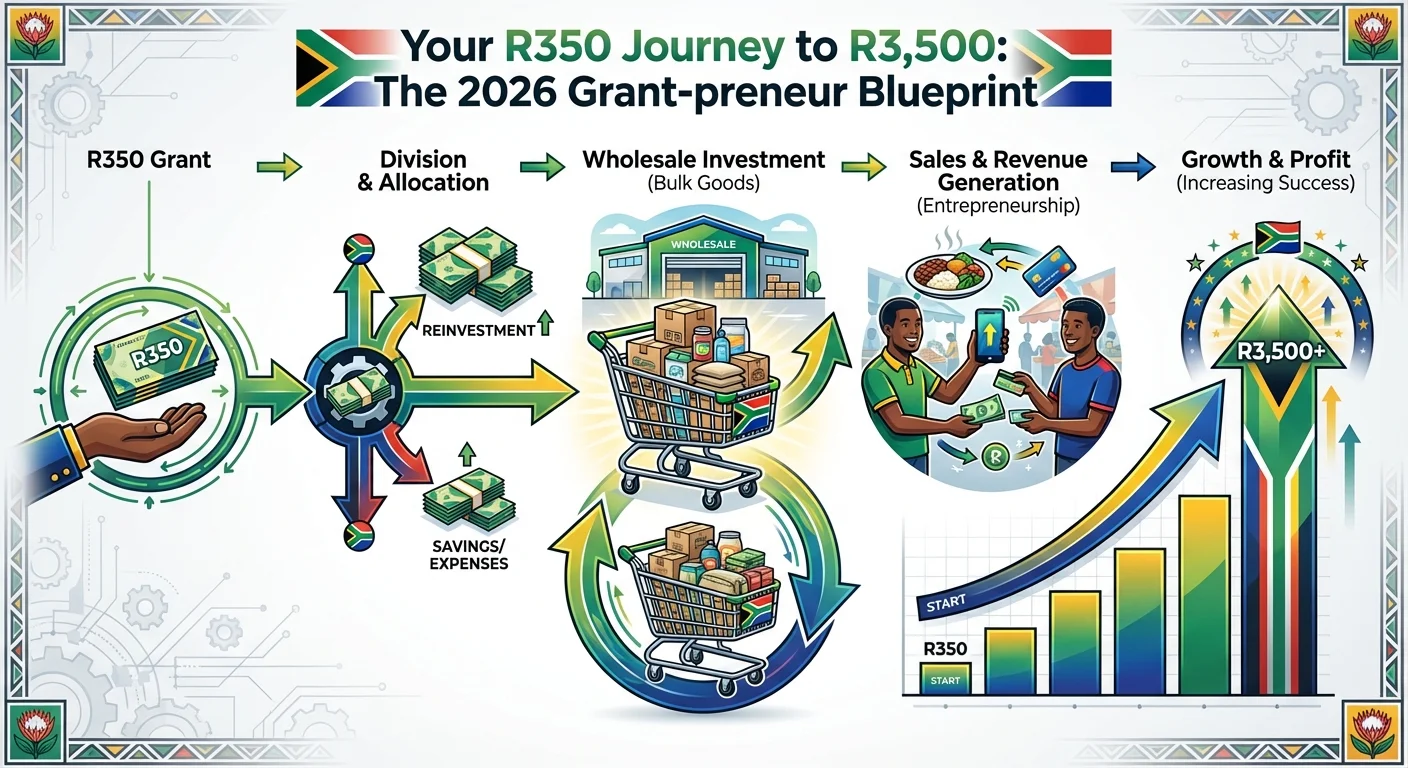
Turning R350 into more requires a disciplined strategy. Here’s the blueprint:
- Step 1: Secure Your Capital. The moment your grant is approved and paid, withdraw the cash. Before you do anything, confirm your grant status is active using the official SRD R350 Status Check portal. This ensures your funding is secure.
- Step 2: Split Your Grant. This is crucial. DO NOT use the full R350. Allocate a strict R200-R250 for your ‘business stock’ and keep R100-R150 for your absolute essential needs. Starving your business before it starts is a recipe for failure.
- Step 3: Buy Your Stock. Go to a wholesaler (like Makro, Boxer, or a local equivalent) to buy your initial products. Buying bulk is key to creating a profit margin.
- Step 4: The First Flip. Your goal is to sell your initial stock within the first week. Focus on turning over the R250 into at least R400.
- Step 5: Reinvest & Scale. Of the R400 you made, take out your initial R250 and reinvest it immediately. Use R50 of the profit for your needs, and put the other R100 profit back into the business. Your next stock purchase is now R350 (R250 initial + R100 profit). This is how you grow.
Leveraging Technology: Your Phone is Your Business HQ
In 2026, you don’t need an office. Your smartphone is your most powerful tool.
- WhatsApp: Create a broadcast list for daily specials. Use your Status to post pictures of your products. It’s free, direct marketing to people who already know you.
- Facebook Marketplace: The number one platform for reaching a wider local audience. Post clear pictures of what you’re selling. It’s perfect for selling items you find and flip for a profit.
- Mobile Banking: Avoid carrying cash. Use an entry-level bank account to accept payments via EFT or cash-send services. It’s safer and helps you track your income.
The Dark Side: Scams to Avoid in January 2026
Where there is opportunity, there are vultures. Be vigilant. Scammers are targeting grant recipients with promises of ‘get rich quick’ schemes.
- The ‘Investment’ Scam: Someone asks you to ‘invest’ your R350 with them for a guaranteed return of R1000 in 24 hours. They will take your money and disappear.
- The ‘Stock Buying’ Scam: They promise to buy ‘high-profit’ stock for you but require an upfront fee. They vanish after you pay the fee.
- The ‘Registration’ Scam: They claim you need to pay a fee to register your small business to be ’legal’. For informal trading at this scale, it’s often not required. Check your local municipal bylaws first.
Rule of Thumb: If it sounds too good to be true, it is. Never give your grant money to someone else to ‘invest’ for you.
Case Study: How Nomusa Turned R350 into a R4,000/month Vetkoek Business
Nomusa, a mother of two from Tembisa, started her journey in late 2025. “The R350 was just not enough for my kids’ transport and food,” she says. “I saw people buying vetkoek every morning at the taxi rank.”
She used her first grant payment to buy flour, oil, and mince. She woke up at 4 AM to start cooking and sold out by 8 AM, making a R150 profit on her first day. Instead of spending it, she reinvested the entire amount into more ingredients. Within three months, she was making over R4,000 per month, employing a neighbour to help her, and had expanded to selling coffee and tea. Her story is not unique; it’s a testament to the power of starting small and being consistent.
What If My Grant is Declined? Your Hustle is on Hold
Your entire plan depends on that initial R350 seed capital. If your application is unfairly declined, you must act fast. A ‘declined’ status can be a major setback. Don’t just give up. Understand the reasons and fight for your grant. We have a comprehensive SASSA Appeals Guide for 2026 that walks you through the exact process of lodging an appeal with the Independent Tribunal. Your hustle depends on it.
The Mindset Shift: From Recipient to Entrepreneur
This journey is more than just about money; it’s a fundamental shift in mindset. It’s about seeing the R350 grant not as a handout, but as a monthly injection of opportunity. It requires discipline, patience, and the courage to start small. The goal isn’t just to make more money; it’s to build resilience and create a degree of financial independence that the grant alone can never provide. Every successful sale, no matter how small, is a step away from dependency and towards self-sufficiency.
Official Resources and Your Next Steps
Empowerment starts with information. For any grant-related issues, always use official channels.
- SASSA Official Website: https://www.sassa.gov.za
- SRD Grant Portal: https://srd.sassa.gov.za
- SASSA Toll-Free Helpline: 0800 60 10 11
- SASSA WhatsApp Status Check: 082 046 8553
Your next step is simple: Make a plan. Decide which hustle fits your skills and your community’s needs. When your next grant payment arrives, you’ll be ready to act, not just spend.
Frequently Asked Questions
Is it legal to use my SASSA grant to start a business?
What is the most profitable business to start with just R350 in 2026?
I'm scared of losing my R350. What is the lowest-risk hustle?
How do I manage my business money separately from my personal money?
My SASSA application was declined. Can I still start a business?
Where can I buy stock cheaply to maximize my profit?
How much profit should I expect to make in the first month?
Do I need to register my business or pay tax on my earnings?
Read Next
Bank App Down? How the 2026 Digital Banking Crisis is Locking You Out of Your R390 SASSA Grant
BREAKING for March 2026: As major South African banks like Capitec, FNB, and …
Your R390 March Grant is Already Gone: How New 2026 Bank Fees Will Eat R40 of Your SASSA Payment
BREAKING for March 2026: Just as SASSA beneficiaries receive their first R390 …
Comments & Discussions