
Table of Contents
An in-depth analysis and guide to the most popular and profitable side hustles for SASSA beneficiaries in December 2025. Learn how to leverage the R350 SRD grant as startup funding for real-world small businesses, from community-based services to digital gigs. This article provides step-by-step plans, cost breakdowns, and success stories for 2025.

The R350 Grant Isn’t Just Aid, It’s Your 2025 Seed Capital
Let’s be honest: surviving on R350 a month in South Africa in December 2025 feels impossible. The price of bread, taxi fare, and data keeps climbing. For years, the conversation around the Social Relief of Distress (SRD) grant has been about survival. But what if we’re looking at it all wrong? As 2025 closes, a powerful new trend is emerging across the country: beneficiaries are tired of just surviving. They are transforming the R350 from a lifeline into a launchpad. This isn’t just a government handout; it’s the smallest, most accessible startup fund in South Africa. This article is not another news report on grant delays. It’s a blueprint. It’s an analysis of the ‘R350 Hustle Culture’ that’s quietly building micro-economies in our communities. We will show you exactly how people are turning that R350 into R1000, R2000, or even R3500 before the next payment cycle even begins.
The Mindset Shift: From Beneficiary to Entrepreneur
The single most important step happens in your mind. The moment you stop seeing the R350 as money to be spent and start seeing it as capital to be invested, everything changes. The economic reality of 2025 demands a new way of thinking. Waiting for grant increases or policy changes is a passive game. The active game is taking what you have, no matter how small, and making it work for you.
Key Mindset Changes:
- Problem-Solver, Not Consumer: Instead of asking ‘What can I buy with R350?’, ask ‘What problem in my community can I solve with R350?’. Is there no one selling airtime after 6 pm? Does everyone have to travel far for fresh vetkoek? Problems are business opportunities.
- Calculated Risks: Starting a small venture has risks, but they are manageable. The risk isn’t losing thousands of rands; it’s losing a portion of your R350. By starting small, you can test your idea without devastating consequences.
- Focus on Cash Flow: The goal isn’t to build a giant company overnight. The goal is to make your initial investment back plus a profit before your next grant payment. This creates a positive cycle of reinvestment and growth.
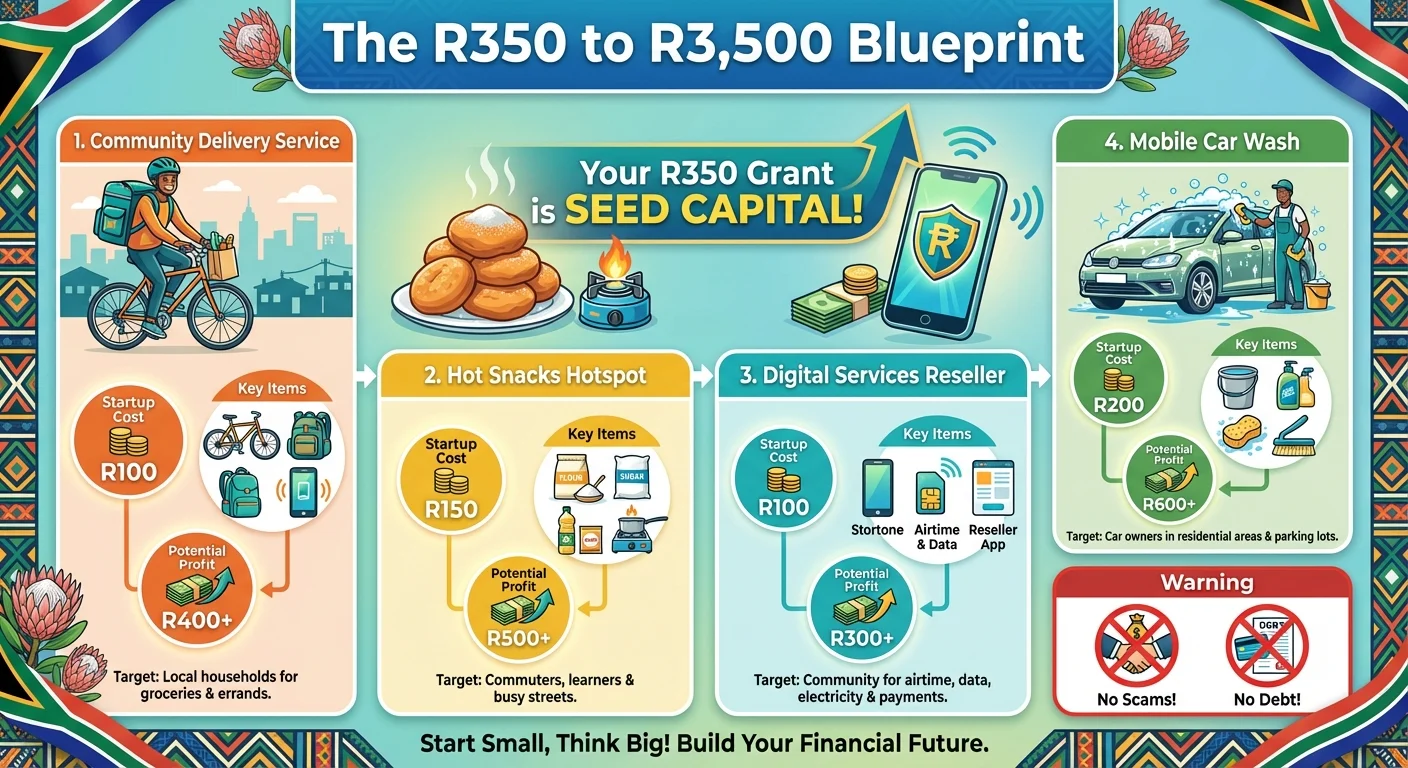
Hustle #1: The Community Delivery Service (Startup Cost: ~R100)
This is one of the fastest-growing micro-hustles, especially in areas where elderly people or busy mothers struggle to get to the shops or SASSA pay points.
- The Idea: You become a personal shopper and delivery person for your immediate neighbours or street. You collect their shopping lists (and money) or offer to stand in queues for them for a small fee.
- Startup Costs: Your main cost is marketing and communication. Use about R50 for data to coordinate via WhatsApp and R50 to print a few dozen simple flyers to put up at local spaza shops or on community notice boards.
- How it Works:
- Offer Your Service: Let people know you can collect groceries, electricity tokens, medication from the clinic, or even withdraw their SASSA grants for them (with their permission and presence for PIN entry, of course, to maintain trust).
- Set Your Fee: Charge a flat fee per trip, for example, R20-R30. If you serve 5-6 people in one trip to the shops, you’ve already made R100-R180.
- Build Trust: Be reliable, honest, and always provide receipts. Your reputation is your biggest asset.
- Earning Potential: If you do this for 10 clients twice a month, that’s 20 trips at R25 each, earning you R500 extra per month. It’s scalable and builds community trust.
Hustle #2: The ‘Hot Snacks’ Hotspot (Startup Cost: ~R150 - R200)
Food is always in demand. You don’t need a restaurant; you just need a single, popular item that you can make better or more conveniently than anyone else.
- The Idea: Sell hot, fresh vetkoek (amagwinya), muffins, or even just boiled eggs with chili spice during peak morning or afternoon traffic times near taxi ranks, schools, or construction sites.
- Startup Costs: This is where you use your R350 as capital.
- 10kg Flour: ~R90
- 2L Cooking Oil: ~R50
- Yeast, sugar, salt: ~R20
- Packaging (small paper bags): ~R15
- Total initial investment: Around R175
- The Numbers: A 10kg bag of flour can produce approximately 200 medium-sized vetkoek. If you sell them for R2 each, your potential revenue is R400. That’s a profit of over R200 from your first batch alone. Reinvest that profit to buy more ingredients and maybe add mince or polony fillings.
- Pro Tip: Get your SASSA payment dates confirmed so you know exactly when you’ll have the capital to buy your first batch of stock for the month.
Hustle #3: The Digital Services Reseller (Startup Cost: ~R50-R100)
Not everyone is comfortable with technology. If you have a smartphone and are good with apps, you can be the tech guru for your community.
- The Idea: Help people with digital tasks for a small fee. This requires almost no physical stock.
- Services to Offer:
- Data/Airtime Sales: Buy data in bulk through your banking app and resell it in smaller amounts for a small profit. Many people don’t have banking apps and buy from spaza shops at a higher markup.
- SASSA Status Checks: Many people still struggle to check their grant status online. Charge R5-R10 to perform the SRD R350 Status Check for them and explain what the status means.
- Job Applications: Help people type and email their CVs or fill out online job applications. Charge R15-R20 per application.
- WhatsApp Setup & Tutoring: Charge a small fee to set up WhatsApp for elders and show them how to make video calls.
- Startup Cost: Your main cost is your own data, so start with a R50 data bundle. Your profit comes from the service fees.
- Earning Potential: Helping 10 people a day with various small tasks could easily net you R50-R100 daily.
Hustle #4: The Mobile Car Wash (Startup Cost: ~R120)
Many people in suburbs and even townships have cars but no time to wash them. You don’t need a fixed location; you just need to be mobile.
- The Idea: Go door-to-door in your neighbourhood offering a car wash service. You bring the supplies, they provide the water.
- Startup Costs:
- 2 Buckets: ~R40
- Quality Car Shampoo: ~R35
- Sponges and cleaning cloths (microfibre): ~R45
- Total initial investment: Around R120
- Pricing Strategy: Charge R50 for an outside wash and R80 for an inside and outside clean. Your first two jobs pay for your entire startup kit. Everything after that is pure profit.
- Marketing: Create a simple WhatsApp message with before/after photos of cars you’ve cleaned and ask your happy customers to share it in their community groups. Word-of-mouth is powerful here.
Important: Will Earning Extra Income Affect My R350 Grant?
This is the most critical question, and the answer for 2025 is clear. The SRD grant has an income threshold. As of late 2025, the threshold is R624 per month. This means you must not have more than R624 coming into your bank account in a calendar month to qualify.
This is why starting small is key. The goal of these side hustles is to supplement your income, not to immediately earn thousands that would disqualify you. As your business grows, you may reach a point where you earn more than the threshold. This should be seen as a success! It means you have successfully used the grant as a stepping stone to financial independence. If your application is ever declined and you believe it’s a mistake, you must be ready to use the SASSA Appeals Guide to state your case. But for now, earning an extra R500-R1000 a month will not automatically disqualify you and will dramatically improve your quality of life.
Warning: Avoid These Traps and Scams in 2025
Where there is desperation, there are scammers. As you start your entrepreneurial journey, be very careful.
- ‘Investment’ Schemes: Avoid anyone on WhatsApp or Facebook promising to ‘double your R350 in 24 hours’. These are almost always pyramid or Ponzi schemes designed to steal your grant money.
- Fake ‘Business Kits’: Be wary of people selling expensive ‘starter kits’ for things like perfume or cleaning products. It’s often better to source your own supplies locally. Your startup costs should be low.
- Giving Away Your Details: Never give your ID number, bank details, or SASSA PIN to anyone promising to ‘register’ you for a business opportunity. Protect your personal information fiercely.
- Going Into Debt: The goal is to use the R350 you have, not to take out loans to start a business. Start small, use your profits to grow, and avoid debt at all costs.
Conclusion: The R350 Revolution is in Your Hands
The economic situation in South Africa remains challenging as we head into 2026. Relying solely on the R350 grant is a recipe for continued hardship. The real power, the real change, is happening at the grassroots level. It’s in the hands of every South African who sees that R350 not as a limit, but as a key.
This December 2025, challenge yourself. Pick one idea from this list. Invest R150 of your grant. See if you can turn it into R300 before the end of the month. The skills you learn, the confidence you build, and the extra income you generate will be worth far more than the initial investment. This is not just about making more money; it’s about taking back control and proving that opportunity can be created, even from the smallest of seeds.
Frequently Asked Questions
Can I really start a business with only R350 in 2025?
If I make extra money, will SASSA cancel my R350 grant?
What is the most profitable side hustle for a beginner?
How do I market my new small business with no money?
My SASSA grant is still pending, what should I do?
Is it better to offer a service or sell a product?
What if my first attempt at a side hustle fails?
How do I know when my next R350 grant is being paid in December 2025?
Read Next
The R150 SASSA Bank Fee Trap: How Banks Are Secretly Draining Your Grant in 2025
While a bank account seems like a safe place for your SASSA grant, hidden fees, …
Why Your SASSA Grant Is Secretly Costing You R500 a Month in 2025
Millions of SASSA beneficiaries are losing hundreds of Rands from their grants …
Comments & Discussions