Table of Contents
Title: Govt’s New ‘Solar Tax’ for the Rich: Is a R150 Eskom Levy Coming for Your R390 SASSA Grant in 2026?
The headlines are full of talk about a new ‘Solar Tax,’ but I’m convinced we’re looking at the wrong thing. While the wealthy move off-grid, a massive threat is building for anyone relying on a SASSA grant in 2026. A proposed R150 Eskom levy could soon devour your R390 grant.
The ‘Solar Tax’ Smokescreen: Why Everyone is Talking About the Wrong Thing
The latest proposal shaking South Africa in April 2026 is the so-called ‘Solar Tax.’ It’s a plan to tax the households and businesses that got tired of blackouts and installed their own panels. National Treasury is floating this idea because Eskom is bleeding money. But while people argue about whether it’s fair to tax someone for being energy independent, I think this is a dangerous distraction for the 9.1 million South Africans living on the R390 SRD grant.
The real story isn’t about the rich paying more. It’s about who is left to carry the weight of Eskom’s failures. As the wealthiest people exit the grid, Eskom is left with a shrinking group of customers and a mountain of debt that will likely hit R500 billion in 2026. The government is desperate. They won’t stop at a solar tax. Their real target will be the millions of people who have no choice but to stay connected, the very people who need every single cent of their SASSA grant just to eat.
Unpacking the R150 ‘Grid Maintenance Levy’: Eskom’s Hidden Plan to Bill the Poor
The proposed ‘Grid Maintenance Levy’ is a new fixed charge that the regulator, NERSA, is looking at for every single household connected to the grid. It doesn’t matter how much power you use. Based on preliminary documents, this levy will likely be around R150 a month.
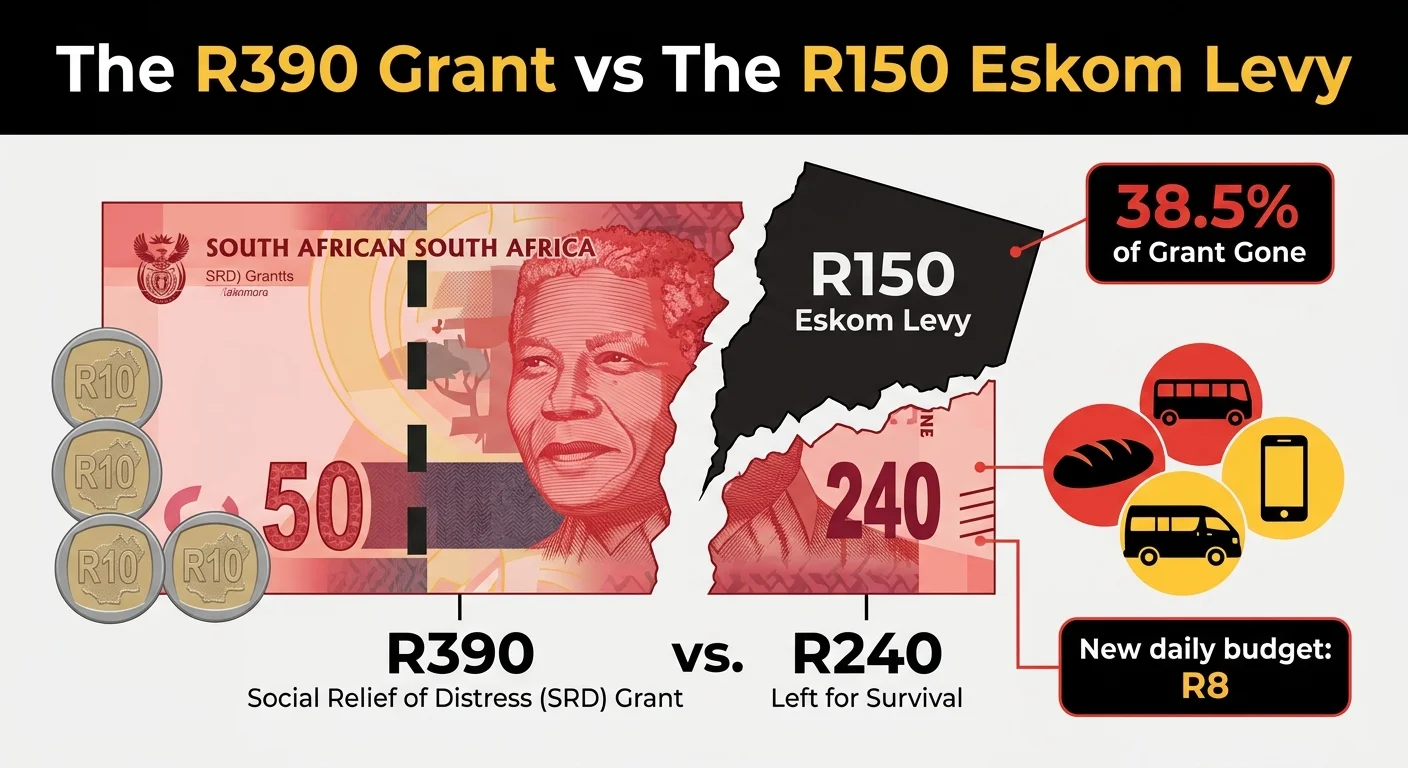
This isn’t a bill for the electricity you actually use. It’s a fee just for the “privilege” of being connected to a wire. For a SASSA beneficiary, this is a total disaster. A R150 levy eats up 38.5% of the R390 monthly SRD grant. It basically wipes out any small increases the government has given over the years. Officials call this “grid stability,” but let’s be honest: it’s a regressive tax. Research from the Institute for Economic Justice shows that poor families already spend way too much of their income on basic power. Dr. Lerato Molefe put it perfectly when she said this isn’t a maintenance fee, it’s a poverty tax that forces the most vulnerable to bail out years of Eskom corruption.
The Numbers Don’t Lie: How 40% of Your R390 Grant Will Vanish
If we look at the math, the situation is grim. By April 2026, the SRD grant is R390. According to Stats SA, you need at least R760 just to buy enough food to survive. The grant already only covers about half of that.
Now, take away that R150 Eskom levy. You are left with R240 for the entire month. That is R8 a day. I don’t know how anyone is expected to pay for food, transport, and airtime on R8 a day. It’s impossible. To make matters worse, this charge happens before you even turn on a light. On top of that, there is a 12.5% tariff hike coming in mid-2026. This is a double blow that makes survival a nightmare. You’ll need to be extremely careful with your money, so make sure you check the Payment Dates to plan your month as tightly as possible.
Our Analysis: A Deliberate Policy Choice to Burden the Vulnerable
This price shock isn’t some accident of economics. It’s a choice made by the Government of National Unity (GNU). When faced with a failing utility and wealthy voters moving to solar, the government is taking the path of least resistance. They are squeezing the poor because it’s easier than fixing the rot at Eskom.
Instead of cutting corruption or fixing the debt, the state is creating a two-tier system. The rich get clean, reliable power they own themselves. The poor get stuck with a collapsing, expensive grid they can’t afford. It feels like a betrayal of the whole point of social grants. The R390 grant should be a safety net, but it’s being turned into a way to subsidize Eskom’s mistakes.
How to Prepare: Your 2026 Survival Guide for the Coming Eskom Price Shock
We have to fight these policies, but in the meantime, you have to protect your wallet. Here are some ways SASSA beneficiaries can try to handle the impact:
- Do a mini energy audit: Unplug everything when you aren’t using it. Chargers, TVs, and microwaves draw “phantom power” that adds up.
- Use Gas or Paraffin (Carefully): Cooking with a small gas stove can be cheaper than using an electric plate, especially for food that takes a long time like pap.
- Manage your geyser: If you have one, only turn it on for an hour a day. It’s the biggest electricity hog in any house.
- Share the load: Talk to your neighbors about sharing the cost of charging phones or using a single solar light if someone has one.
- Stick to Prepaid: Never get an electricity account. Prepaid lets you buy R20 at a time so you don’t end up with a bill you can’t pay.
- Apply for Indigent Support: This is vital. Go to your municipal office and register for the indigent subsidy. It gives you a small amount of free electricity every month. If your grant is currently giving you trouble, do an SRD Status Check to make sure your paperwork is in order before you apply at the municipality.
Frequently Asked Questions
Will the R150 Eskom levy be deducted directly from my SASSA grant?
What is the 'Solar Tax' and does it affect me as a grant recipient?
Is the R150 levy and the electricity tariff hike for 2026 confirmed?
How can I get free basic electricity from my municipality?
My SRD grant was declined. Can I still get help with electricity?
Will using less electricity really make a difference against a R150 fixed fee?
Read Next
SASSA June Payment Update: June 2026 Payment Cycle Confirmed
The June 2026 SASSA payment cycle is confirmed for 2, 3 and 4 June 2026 for the …
The R50 Billion Food Waste SHOCK: Why Your R390 SASSA Grant Can't Buy Food While SA Throws It Away
BREAKING May 2026: A shocking new report reveals South Africa wastes over R50 …
Comments & Discussions