Table of Contents
Title: Home Affairs’ ZEP Crackdown: Is Your R390 SASSA Grant at Risk if Your Partner is Foreign in 2026?
If you are one of the millions of South Africans relying on the R390 SASSA grant to survive, the latest news from Home Affairs is enough to keep you up at night. This guide looks at the 2026 ZEP crackdown and how SASSA’s new data-matching with Home Affairs could flag your grant. I want to explain the legal mess of the ‘household income’ test for mixed-nationality families and give you a clear plan to keep your money from being suspended.
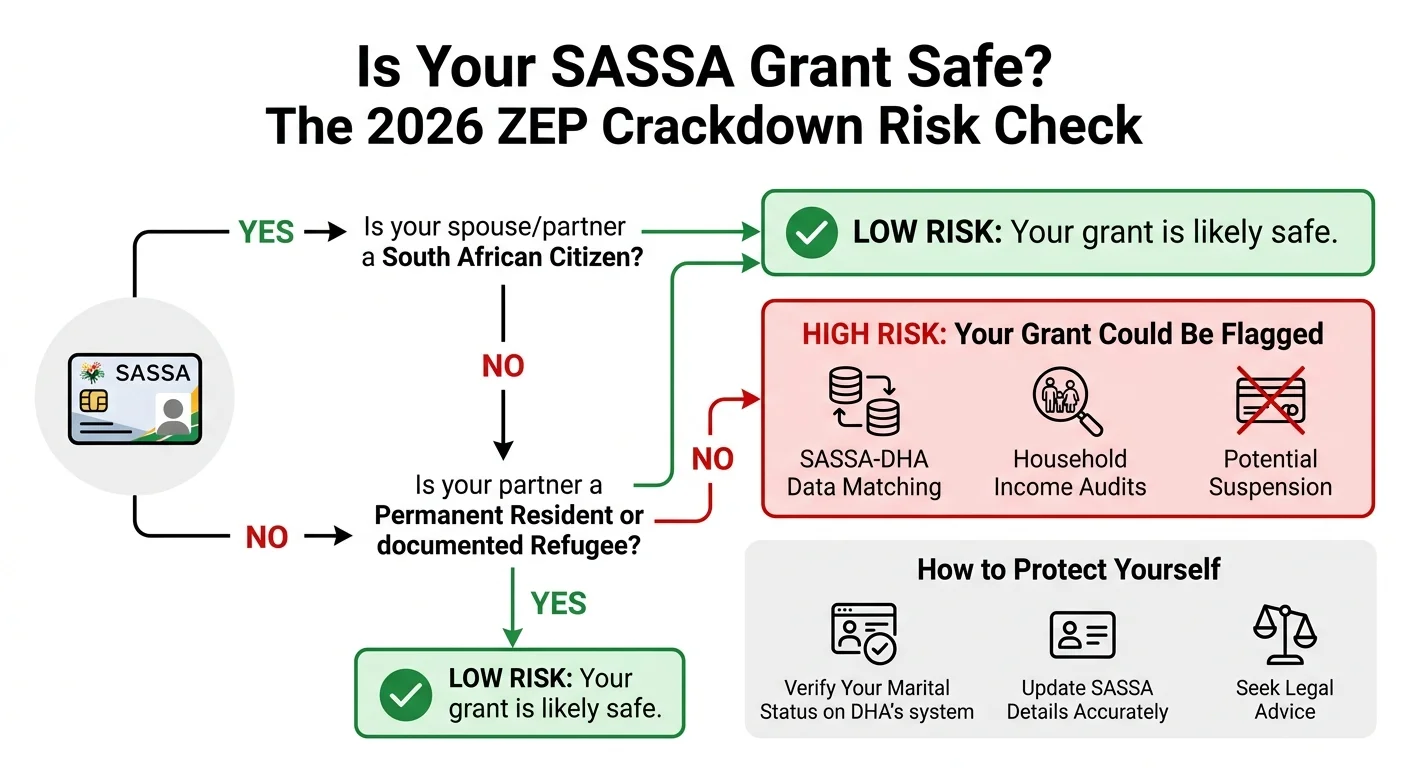
The 2026 ZEP Crackdown is Here: Why It Matters for Your SASSA Grant
The Department of Home Affairs has really turned up the heat on expired Zimbabwean Exemption Permits (ZEPs) this April 2026. It’s a move that is sending shockwaves through thousands of families across South Africa. News24 reports that immigration enforcement is at an all-time high, affecting about 178,000 people who were on ZEPs.
For many South Africans getting SASSA grants, this feels like more than just a headline, it’s a direct threat to their lives. The problem is that while you are a citizen entitled to your R390 SRD grant, living with an undocumented partner can now trigger automated red flags in the system. SASSA’s 2026 reports show a massive spike in grant suspensions because they are now sharing data directly with Home Affairs. This means your lifeline could be cut off, not because of anything you did, but because of who you love.
The ‘Household Income’ Test: How a Foreign Partner Triggers a SASSA Red Flag
The real danger to your money comes from the ‘household income’ test. SASSA is incredibly strict about the R390 SRD grant, insisting you have no other support. Even though your foreign partner can’t claim a cent from SASSA, their presence in your home makes things messy.
The system is now built to look at the whole household, not just you. If you are married to or living with someone, SASSA assumes you are helping each other out financially. But an undocumented partner has no legal way to work and no official income records. This creates a “data vacuum.” SASSA’s computers usually react in two ways: they either flag you for a manual review that takes months, or they just assume you have hidden income. Analyst Zama Khumalo says the system isn’t built for the reality of poverty in mixed-nationality homes. It sees a gap in the data and raises a flag, leaving you to prove you’re actually starving while supporting someone who isn’t allowed to work.
SASSA & Home Affairs Data-Matching: The New System That Could Suspend Your Grant
A new deal signed in 2026 gives SASSA total access to the Home Affairs National Identification System (HANIS). This is the engine behind all these recent suspensions. SASSA can now instantly check your ID against marriage records. If the system sees you are married to someone with an expired permit, your grant is flagged.
It’s a huge change from how things used to work when the departments barely spoke to each other. To me, this feels like people are being punished for their personal relationships. The government says it’s about stopping fraud, but it’s hitting the most vulnerable people instead. The Black Sash Advocacy Group points out that this automated checking doesn’t care if you are the only one in the house with an income. If your grant stops suddenly, this data-matching is usually the reason. You need to be checking the SRD Status Check portal constantly to stay ahead of it.
Are You Legally Obligated to Support Your Partner? The Law vs. SASSA’s Rules
South African law has this thing called a ‘duty of support’ between spouses. This creates a massive legal trap. To get the R390 SRD grant, you have to prove you have ‘insufficient means’ and no other help. But if you’re married, SASSA can argue that your spouse is legally required to support you.
It doesn’t matter if your spouse is undocumented and hasn’t had a job in years. SASSA might still reject you, claiming you have a “potential” source of money. Lawyers for Human Rights are calling this a complete misapplication of the law. They argue that SASSA needs to look at the facts, not just legal concepts. If a spouse has no money and no right to work, there is no support. Rejecting a grant because of a theoretical duty of support is just cruel. This is where most people end up winning their appeals, but you have to be ready to fight and provide affidavits.
Protecting Your R390 Grant: A 3-Step Action Plan for Mixed-Nationality Families
If you are in this situation, you can’t afford to be passive. You have to be proactive to keep your R390 grant safe. This won’t fix your partner’s papers, but it might keep your head above water.
Step 1: Double-Check Everything. Go to the SASSA SRD website and make sure every single detail is right. Your name, ID, and especially your marital status must match what Home Affairs has. If there is even a tiny difference, the system will flag you for fraud.
Step 2: Get Ready for an Appeal. Don’t wait for the “declined” message to start learning how the system works. Read up on our Appeals Guide now. You’ll need to know how to write an affidavit explaining that you are the only one bringing in money. Being fast is the only way to win.
Step 3: Keep Your Money Separate. I can’t stress this enough: do not use a joint bank account for your SASSA money. Keep your account in your name only. It makes it much easier to prove that the R390 is your only income and that you aren’t getting “other financial support” from your partner’s side.
Frequently Asked Questions
Can my foreign spouse or partner receive a SASSA grant in 2026?
Will SASSA automatically cut my grant if my partner is undocumented?
Do I have to tell SASSA that my partner is an undocumented foreign national?
What is the first thing I should do if my grant is suspended because of this?
Does my partner's ZEP status affect my children's Child Support Grant?
Where can my partner get legal help for their immigration status?
Read Next
SASSA June Payment Update: June 2026 Payment Cycle Confirmed
The June 2026 SASSA payment cycle is confirmed for 2, 3 and 4 June 2026 for the …
The R50 Billion Food Waste SHOCK: Why Your R390 SASSA Grant Can't Buy Food While SA Throws It Away
BREAKING May 2026: A shocking new report reveals South Africa wastes over R50 …
Comments & Discussions