Table of Contents
With the NHI Act finally kicking in for 2026, I know millions of people on SASSA are panicking about whether their R390 grant is actually safe. It is a valid concern. This look at the new system explains how the NHI connects to your social grant, what you need to do to get your NHI card, and whether those rumors about “health taxes” are true.
BREAKING: NHI is Here. What Every SASSA Grant Holder MUST Know in March 2026
The news that millions have been waiting for, and honestly dreading, arrived in late March 2026. The government has officially started rolling out the National Health Insurance (NHI) scheme in phases. While politicians are busy calling this a massive win for equality, if you are one of the 9 million South Africans living on the R390 Social Relief of Distress (SRD) grant, you probably have a more urgent question: Who is paying for this?
There is a lot of fear in our communities right now that the government will take a “health tax” directly from your grant money. I’ve looked at the Department of Health’s latest updates, and they claim the NHI is meant to include you, not tax you. But there is a catch. You have to get an NHI Card. Think of it like a second ID specifically for the clinic. If you don’t get one, you might find yourself locked out of services that used to be free. The reality for March 2026 is that while your cash seems safe for now, your right to see a doctor now involves a whole new mountain of paperwork.
The R390 Question: Will SASSA Grants Be Deducted for an NHI ‘Health Tax’?
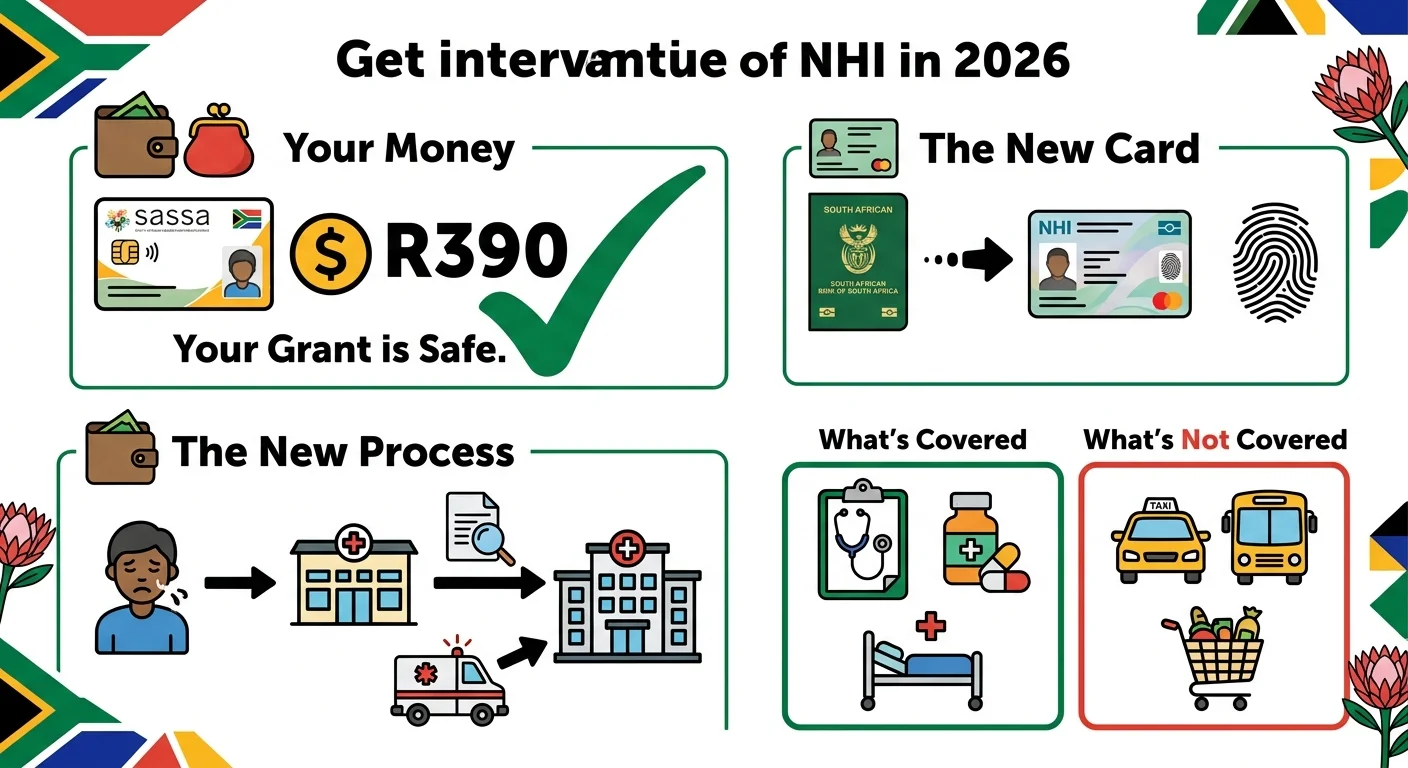
I want to be very direct about the biggest fear out there: No, they are not going to take money out of your R390 SASSA grant to pay for the NHI. The National Treasury’s 2026 budget shows that the billions needed for this rollout are coming from general taxes and shifting provincial health budgets around. They aren’t touching social grants.
Social policy expert Dr. Thandiwe Khumalo says that taxing social grants would be a political disaster and would hurt the very people the NHI is supposed to help. For now, the funding plan focuses on people with high salaries and big companies.
So why is everyone so worried? It’s because the government uses confusing words like “universal contribution.” While people with jobs might eventually pay a payroll tax, SASSA recipients are exempt. The R390 grant is seen as survival support, not income you can be taxed on. Your money is safe. However, I am worried about the “hidden” cost of time and taxi fare. You’ll have to travel to register for your card, and that isn’t free. Make sure you check our Payment Dates page so you can plan your trip to the registration office when you actually have cash in hand.
Your SASSA Card vs. The New NHI Card: A 2026 Guide to Your Two Most Important Cards
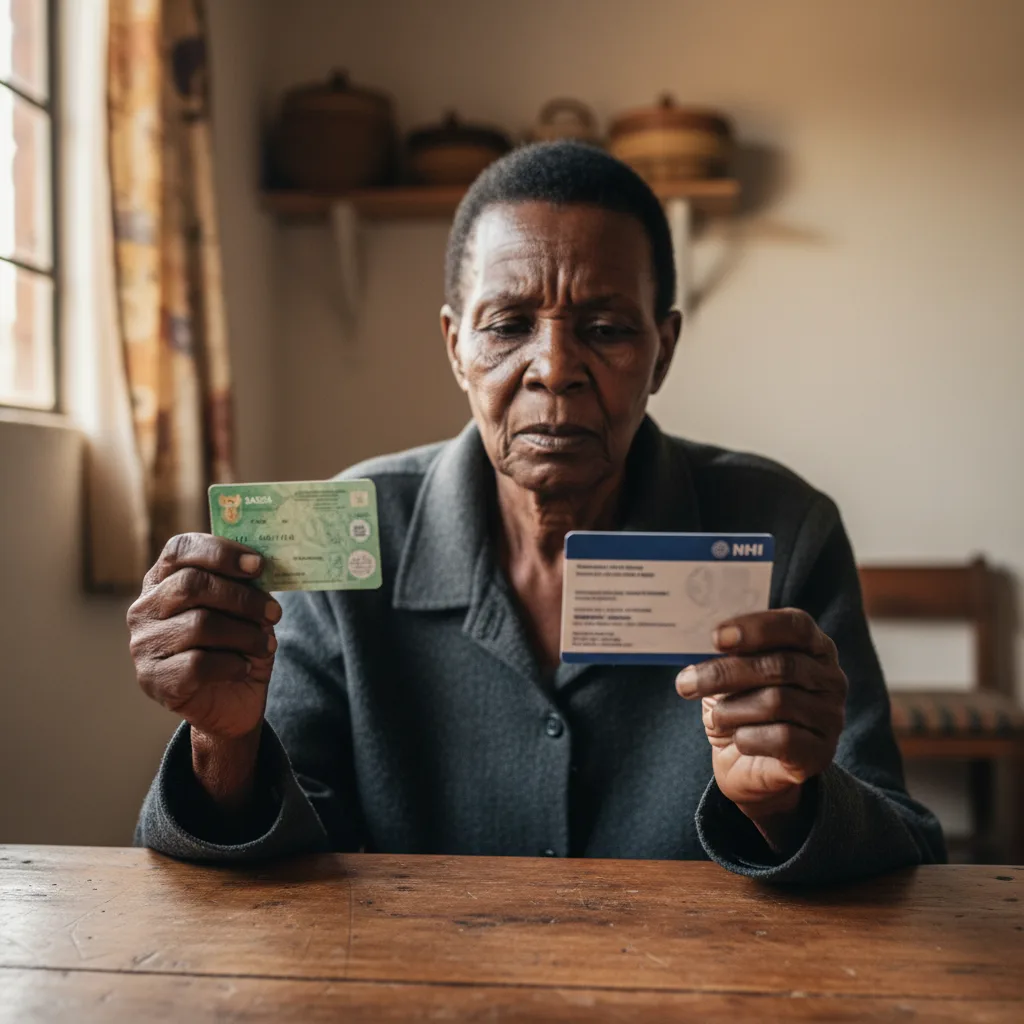
By the time we hit the middle of 2026, you are going to need two different cards to get by. One is for your money, and one is for your health. Don’t get them confused.
Your SASSA Card (or Bank Account):
- What it’s for: Getting your R390 grant every month.
- Who runs it: SASSA and the banks.
- How it works: You use it at the ATM or Shoprite to get your cash.
- The NHI Link: Being an active SASSA beneficiary is actually your “golden ticket” because it proves you qualify for free NHI registration without any hassle.
The New NHI Card:
- What it’s for: Getting into a clinic or hospital.
- Who runs it: The Department of Health.
- How it works: It has a unique number that a nurse will scan to see your medical history. You cannot get treated without it.
- Registration: This is the annoying part. You have to go to Home Affairs or a local clinic in person to get this done. You’ll need your South African ID.
Basically, SASSA proves you are eligible for the help, but the NHI card is what actually lets you through the clinic door. If your grant is “pending” or “declined,” it might make your NHI registration much harder. I highly recommend doing a SRD R350 Status Check to make sure your records are clean before you try to register for the health card.
‘Free’ Healthcare? Unpacking the Hidden Costs and Changes at Your Local Clinic
The NHI promises “free” care, but things are changing on the ground in a way that might feel restrictive. The new system relies heavily on referrals. You will be assigned to one specific local clinic. That is your “home” base. You can’t just decide to go to a big hospital because you think the service is better there.
The New Process:
- The Local Clinic: You have to go here first for everything.
- The Referral: If you’re really sick, a nurse has to give you an electronic referral.
- The Hospital: You can only go to the hospital if you have that digital referral. If you just show up, they might turn you away unless it’s a life-or-death emergency.
This is where it gets tough for SASSA beneficiaries. You lose the choice of where to go. Also, transport is a massive issue. A 2026 report from Section27 found that the average round trip to a facility costs about R85. That is nearly 22% of your R390 grant just to use “free” healthcare. The medicine might be free, but getting to it is getting more expensive.
How to Register for NHI as a SASSA Beneficiary: Your Step-by-Step Action Plan
The Department of Health is starting a big registration drive in mid-2026. Since you get a SASSA grant, you are at the front of the line. Here is how you do it:
Step 1: Gather Your Paperwork Grab your green ID book or Smart ID. Make sure your name and ID number match what Home Affairs has on file. It helps to have a recent SASSA SMS or bank statement ready just in case they ask for proof of your grant.
Step 2: Find a Registration Point You can’t do this on your phone yet. You have to show up in person at:
- Local Home Affairs offices.
- Public hospitals.
- Mobile units (vans) that visit rural areas and SASSA pay points.
Step 3: Fingerprints and Photos They will take your photo and scan your fingerprints. This links your medical record to your ID so nobody else can use your benefits.
Step 4: Get Your Card Once they verify your details, you’ll get your NHI Card. Treat this like gold. If you lose it, getting back into the system could be a nightmare.
If your SASSA grant was recently stopped or declined for a weird reason, you need to fix that first. Use our Appeals Guide to get your status back to “Approved” before you head to the NHI registration desk.
Frequently Asked Questions
Will my R390 SASSA grant be cut because of NHI in 2026?
Do I need to use my grant money to pay for NHI services?
How do I get my NHI card if I am a SASSA beneficiary?
Will I lose my SASSA grant if I don't register for NHI?
Can I still go to any public clinic for free with NHI?
What happens if my SASSA grant status is 'Pending' or 'Declined'?
Read Next
The R35 'Silent Tax': How Hidden Bank Fees Are Stealing 10% of Your April 2026 SASSA Grant
BREAKING March 2026: While beneficiaries focus on the R390 grant amount, major …
The R390 vs R4,488 Minimum Wage Gap: Why Your April 2026 SASSA Payment is More Critical Than Ever
BREAKING ANALYSIS for April 2026: As South Africa’s new minimum wage rises …
Comments & Discussions