Table of Contents
Title: SASSA March 2026 Payments: Your Human Rights Day Grant & The R500 ‘Confirmation’ Scam
I’ve been looking at the calendar for the SASSA March 2026 payment schedule, and there is one big question on everyone’s mind: will the Human Rights Day holiday mean we get our money early? While we wait for the official word, I’m also seeing a nasty R500 SMS scam that is trying to steal grant money from those who need it most.
March 2026 SASSA Payments: Will Human Rights Day Mean an Early Payout?
As March 2026 gets closer, over 18 million people are wondering if the Human Rights Day holiday on Friday, March 21st, will push payment dates forward. For the latest official word, I always recommend checking our SASSA Payment Dates page. Usually, SASSA tries to move things around so people aren’t left stranded over a long weekend, often paying out on the business day right before the holiday.
This shift is helpful, but the waiting period is a dangerous time. Criminals know people are anxious. According to a 2026 poverty report from Stats SA, about 60% of people getting the SRD grant spend that entire R370 within just five days of receiving it. That kind of financial pressure is exactly what scammers look for—they prey on the desperation for funds to arrive.
BREAKING: The New R500 ‘Confirmation Fee’ Scam Exploiting Early Payment Hopes
I am seeing a really heartless new scam popping up on SMS and WhatsApp this February. It’s specifically designed to trick you into thinking you can get your March payment early. The SAPS Cybercrime Unit just put out a warning about it.
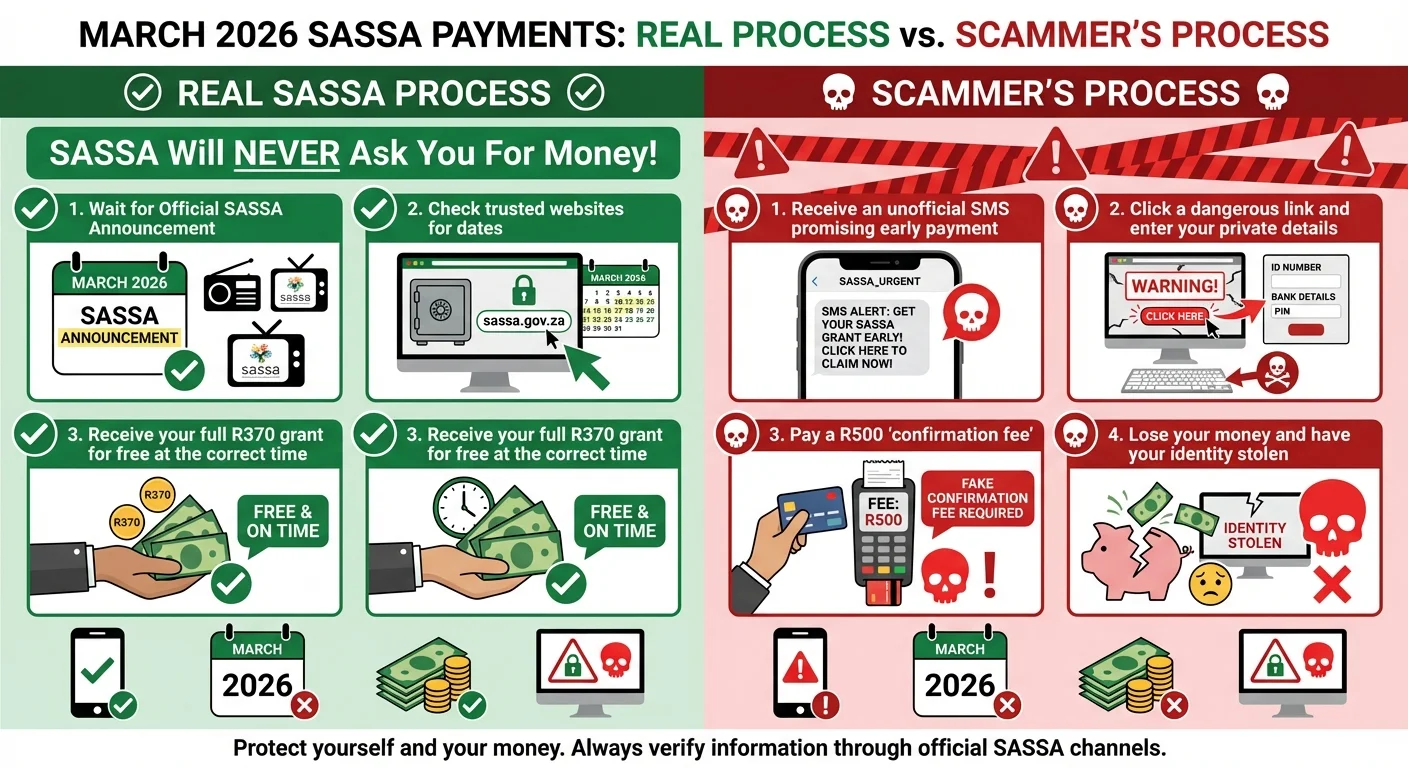
The message looks very official. It says something like: “SASSA ALERT: Your March 2026 grant is scheduled for early payment due to Human Rights Day. To confirm your spot and receive funds within 24 hours, pay a R500 reflection fee.” They then tell you to send the money through an e-wallet or a store voucher.
Let me be very clear: THIS IS A SCAM. SASSA will never ask you to pay a fee to get your own money. Your R370 grant is a right, not something you have to buy. These criminals are asking for R500 because it sounds like a “premium service” fee, but it’s just a way to rob you. SABRIC data shows that these types of “advance fee” scams cost South Africans more than R150 million in 2025 alone.
How Scammers Get Your Number: The Post-Data Leak Reality of 2026
It’s frustrating to think about, but these scammers likely have your details because of the massive data leaks we’ve seen lately. After the Department of Home Affairs leak in early 2026, criminals ended up with the names, ID numbers, and phone numbers of millions of us.
They use this info to make their lies sound true. When a message has your actual name or the last few digits of your ID, it’s easy to believe it’s real. But remember: just because they know who you are doesn’t mean they are official. You have to treat every single message about your grant with a lot of suspicion.
Your 3-Step Action Plan to Verify Payment Dates & Avoid Scams
To keep your R370 grant safe, you have to be your own gatekeeper. Don’t believe rumors you hear on the street or in a WhatsApp group. Here is how I handle it:
- Stick to Official Sources: The only info you should trust comes from SASSA itself or a site like ours that links directly to their updates. If you see it on a random social media post, ignore it. You can always see the verified dates on our Payment Dates page.
- Never, Ever Pay a Fee: This is the most important rule. If anyone asks for money to “unlock” or “speed up” your grant, they are a thief. There are zero fees for SASSA grants. If you get a message like that, block the number and delete it.
- Don’t Touch Unknown Links: These messages often have links to fake websites that look just like the real SASSA portal. They want your ID number and your PIN. Once you give them that, they can take everything. If you need to check your status, type the address yourself or use our SRD Status Check guide.
What to Do If You Have Fallen Victim to the Scam
It is a terrible feeling to realize you’ve been tricked, but you have to act fast to try and fix it. If you already sent that R500 or put your details into a weird website, do this right now:
- Call Your Bank: If you gave away bank info, call their fraud line immediately. They might be able to freeze your account before the scammers take more.
- Go to the Police: Find your nearest SAPS station and open a fraud case. Bring the messages, the phone number that texted you, and any payment proof. You’ll need that case number if you want the bank to help you later.
- Change Your SASSA PIN: If you have a SASSA card, get to a SASSA office or a store that does withdrawals and change your PIN immediately.
- Report the Number: Block the sender on WhatsApp and report them. You can also tell your mobile network provider about the SMS scam.
The Bigger Picture: Why SASSA’s Communication Gaps Fuel Scams
I keep thinking that this R500 scam only works because SASSA isn’t great at communicating. When the government doesn’t give clear info until the very last minute, it creates a “vacuum” where people feel anxious and uncertain.
Social analyst Themba Khumalo wrote something in the Daily Maverick that I really agree with: “The information gap between a SASSA announcement and the beneficiary’s understanding is where criminals build their empires.” If SASSA had a better way to tell people exactly when they were getting paid weeks in advance, these scams wouldn’t stand a chance. Until that happens, we have to look out for each other and keep sharing the right information.
Frequently Asked Questions
Will SASSA definitely pay the March 2026 grants early for Human Rights Day?
What does the R500 'confirmation fee' scam message look like?
Is it safe to click links in SMSs about my SASSA grant?
How can I officially check my March 2026 SASSA payment date?
Does SASSA use WhatsApp to communicate payment dates?
082 046 8553), but they won’t text you out of the blue to tell you a date or ask for money. Any unsolicited message like that is a scam.I paid the R500 scam fee. Can I get my money back?
Read Next
SASSA's New 'Mandatory App' Locks Your R390 Grant? The 2026 Guide for Beneficiaries Without a Smartphone
BREAKING April 2026: SASSA is rolling out a mandatory new smartphone app, …
The R140 Paraffin Price SHOCK: How 40% of Your R390 SASSA Grant Will Vanish on May 1st, 2026
BREAKING April 2026: NERSA has approved a devastating 40% increase in the price …
Comments & Discussions