

Table of Contents
Title: Goodbye R390 SRD? The GNU’s New ‘Points-Based’ SASSA Grant for 2026 Explained
The SASSA R390 SRD grant is on its way out, and a new R550 ‘Khulani’ grant is taking its place in 2026. This isn’t just a simple name change or a small top-up. It is a complete overhaul of how South Africa handles social support, introducing a controversial points-based system that could leave millions of people behind.
The End of an Era: Why the R390 SRD Grant is Being Scrapped
The R390 Social Relief of Distress (SRD) grant is being phased out by April 2026. I’ve been looking at the policy framework released by the Government of National Unity, and the tone is clear. They think the current SRD grant, which helps over 8.8 million South Africans, is “passive.” In government-speak, that means they don’t like giving out money without strings attached. The GNU is under heavy pressure from the National Treasury to cut costs, and they’ve decided that the best way to do that is to turn social support into a reward for “active citizenship.”
It feels like a massive gamble. Data from Stats SA at the end of 2025 shows youth unemployment is still sitting at a staggering 65%. Dr. Elize Mthembu from Wits University points out that this shift is a huge ideological change. The government is betting that if they force people to be “active,” the economy will somehow fix itself. But I worry about the people who can’t just “activate” their way out of poverty. The old SRD system was messy and full of glitches, but it was a lifeline. This new ‘Khulani’ grant is a different beast altogether. It’s not just about being poor anymore; it’s about proving you are “useful” to the economy.
The ‘Khulani’ Grant: How the New R550 Points-Based System Works
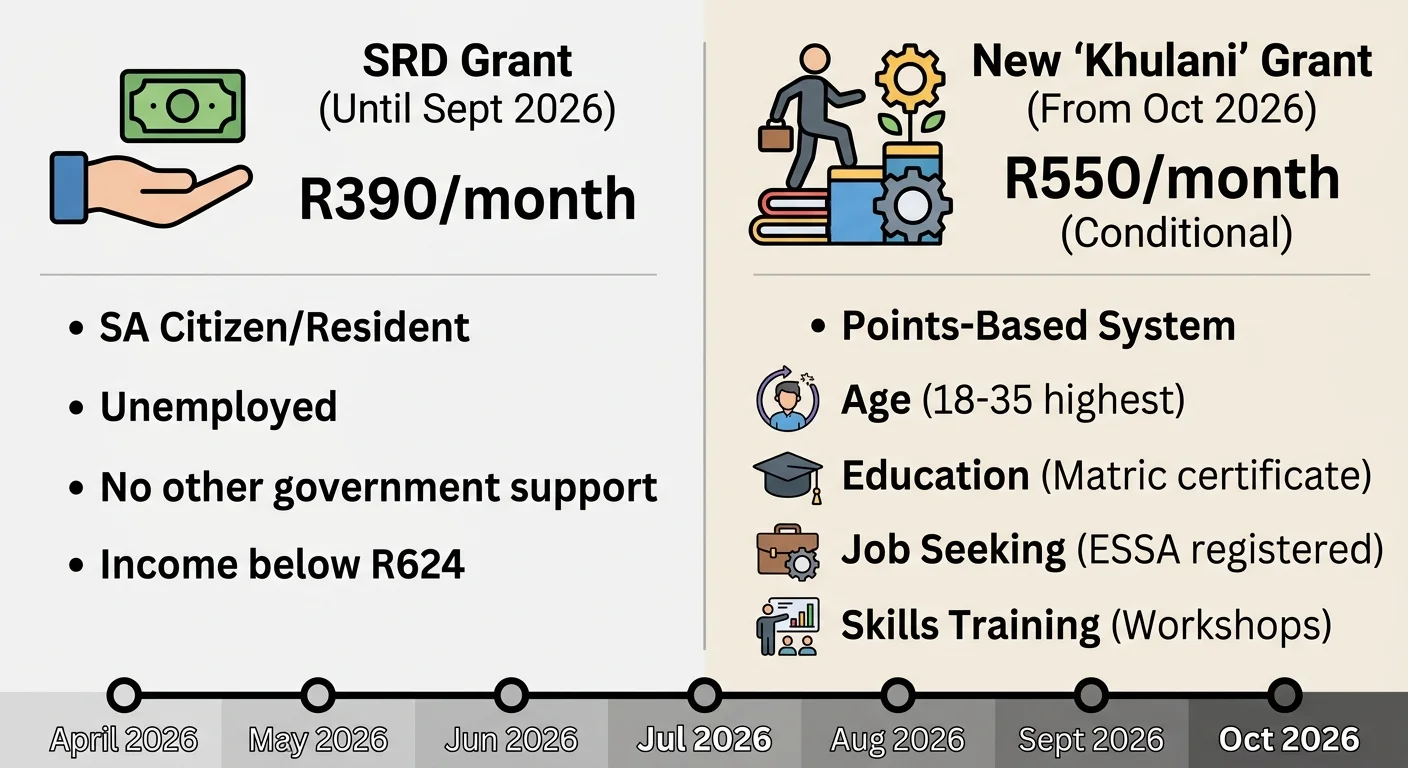
The new ‘Khulani’ Grant starts with a baseline of R550, which sounds good on paper. But there is a catch. You don’t just get it because you have no income. You have to earn enough points to qualify. A leaked memo from the Department of Social Development (DSD) shows a scoring matrix that clearly favors younger people.
Here is how the points are likely to be handed out:
- Age Bracket: If you are between 18 and 35, you get the most points. If you are older, your score drops.
- Education Level: Having a Matric certificate is a huge deal here. If you have a degree or even a short-course certificate, you get maximum points.
- Work-Seeking Activity: You have to be registered on the Department of Labour’s ESSA database. You get more points if you can prove you’ve attended job workshops or skills training.
- Dependents: You might get a few points for having kids, but the system cares way more about your “economic potential.”
- Geographic Location: There might be a small boost for people in rural areas, but the details are still blurry.
Think about how this works in reality. A 25-year-old with a Matric who is constantly applying for jobs will probably get the R550. But a 45-year-old who never finished school and lives in a remote village might be rejected, even if they are starving. It feels cold, and it completely changes the relationship between the state and the unemployed.
Winners and Losers: The Controversial Impact of the New System
This points-based system is going to create a two-tier society of grant recipients. The “winners” are easy to spot. If you are young, educated, and living in a city like Johannesburg or Pretoria where workshops are easy to find, the R550 will be a welcome boost. For a 22-year-old in Gauteng with a Matric and an active ESSA profile, this system works.
But the “losers” are the people who are already struggling the most. This is the part that really concerns me.
- Older Unemployed People (36-59): This group is being sidelined. They get fewer points for their age and often don’t have the modern qualifications the government is looking for.
- People Without a Matric: In 2025, about 48% of unemployed adults in South Africa didn’t have a Matric. This policy basically punishes them for a failing school system they had no control over.
- Rural Residents: It’s all well and good to say people must register online or attend workshops. But what if there’s no internet? What if the taxi to the nearest town costs more than the grant itself? These people face a “poverty penalty.”
The Black Sash has already come out swinging against this, saying the system punishes people for being poor. They are right. It assumes that if you aren’t working, it’s because you aren’t trying hard enough, which ignores the reality of our economy.
The Transition Plan: Will Your R390 Grant Stop Suddenly?
The good news is that your R390 SRD grant won’t just vanish overnight. The DSD knows that a sudden cut would cause a disaster. They are planning a phased transition that should last until about September 2026. If you want to keep track of when your current money is coming, keep an eye on the Payment Dates page.
Here is what the timeline looks like:
- April - June 2026: You’ll start seeing lots of ads and posters explaining the ‘Khulani’ Grant. Your R390 payments will stay the same for now.
- July 2026: SASSA will launch a new app and website for pre-registration. This is when you’ll have to start uploading your Matric certificates and proof of training.
- August - September 2026: They will start processing the first batch of applications, starting with younger people.
- October 2026: This is the big month. The first R550 ‘Khulani’ payments go out, and the old SRD grant officially ends for those who moved over or were rejected.
Don’t expect this to happen automatically. You will have to apply all over again. It’s going to be a lot like the process in our How to Apply SRD guide, but you’ll need way more paperwork this time.
Your Action Plan: How to Prepare for the ‘Khulani’ Grant Shake-Up
You cannot afford to sit back and wait for 2026. If you rely on this money, you need to start moving now. Here is what I would do if I were in your shoes:
- Get Your Papers in Order: Find your Matric certificate. If you lost it, go to the Department of Basic Education today and apply for a new one. It takes forever, so don’t wait. Make sure your ID is valid too.
- Get on the ESSA Database: This is vital. Go to the Department of Labour website and sign up for the Employment Services of South Africa (ESSA). If you aren’t on that list, you probably won’t get the points you need.
- Find a Course: Look for any free training you can find. Local libraries or NGOs often have basic computer or CV-writing classes. Get a certificate for everything you do. Those pieces of paper are now worth money.
- Check Your SASSA Details: Make sure your phone number and bank details on the current SASSA portal are correct. If they try to text you about the new grant and your number has changed, you’re going to have a hard time.
- Watch the News: Things change. The government might tweak the points system if there’s enough public outcry. Stay informed so you aren’t caught off guard.
Frequently Asked Questions
Will my R390 SRD grant stop immediately in April 2026?
What is the new 'Khulani' Grant amount?
How will the new points system be calculated?
What happens if I don't have a Matric certificate?
When does the new 'Khulani' Grant system officially start?
Do I have to re-apply, or will I be moved automatically?
What if I get declined for the new grant?
Read Next
SASSA's New 'MySA Gov' Portal Glitch: Your R390 Grant 'Vanished'? The 2026 Fix-It Guide
BREAKING April 2026: The new mandatory ‘MySA Gov’ portal for all …
SASSA's R1.2 Billion Corruption Scandal: Your R390 Grant Safe? New 'Anti-Corruption Dashboard' for 2026 Revealed
BREAKING April 2026: An explosive SIU report reveals R1.2 billion in social …
Comments & Discussions