
Table of Contents
Title: SASSA’s New ‘Household Test’ for 2026: Why Living with Family Could Cost You Your R390 Grant
If you’re one of the millions relying on the SASSA R390 grant, the rules of the game are about to change in a way that feels incredibly unfair. The government’s new ‘Household Means Test’ for 2026 isn’t just a small update. It is a fundamental shift that could leave you empty-handed simply because of who you share a roof with.
The Bombshell Announcement: What is the New ‘Household Means Test’?
On March 9, 2026, the Department of Social Development (DSD) dropped a bombshell that is going to make life a lot harder for people already struggling to get by. Starting May 1, 2026, SASSA is rolling out a new ‘Household Means Test’ for the R390 Social Relief of Distress (SRD) grant. For years, the government only cared about your personal income. Now, they want to see the “big picture” of everyone living in your home.
This new policy forces you to prove that you aren’t benefiting from a combined household income that sits above the poverty line. It doesn’t matter if your own bank account is at zero. If the people you live with earn “too much,” you’re out. The DSD claims they want to stop “grant leakage” to people who don’t really need it, but I’m worried this is going to hurt the very people it’s supposed to help. Stats SA reported in 2025 that over 35% of SRD recipients live in multi-generational homes. That’s 3 million people who are now under a microscope.
Why Now? The Government’s War on ‘Household Fraud’
The reason for this sudden crackdown comes from a 2025 Auditor-General’s report. They found what they call “grant clustering”—basically, too many grants going to the same address. The government thinks people are gaming the system. They’re worried about unemployed adults living with well-off parents and still collecting a grant.
Social Development Minister Lindiwe Zulu was very clear in a recent press conference, saying the SRD grant is for the “destitute,” not a “supplementary income.” While that sounds fine on paper, the reality is much messier. The government is now treating a household as a single “economic unit.” This ignores the way South African communities actually work. Just because you share a kitchen doesn’t mean you share a paycheck, but the government seems to have forgotten that.
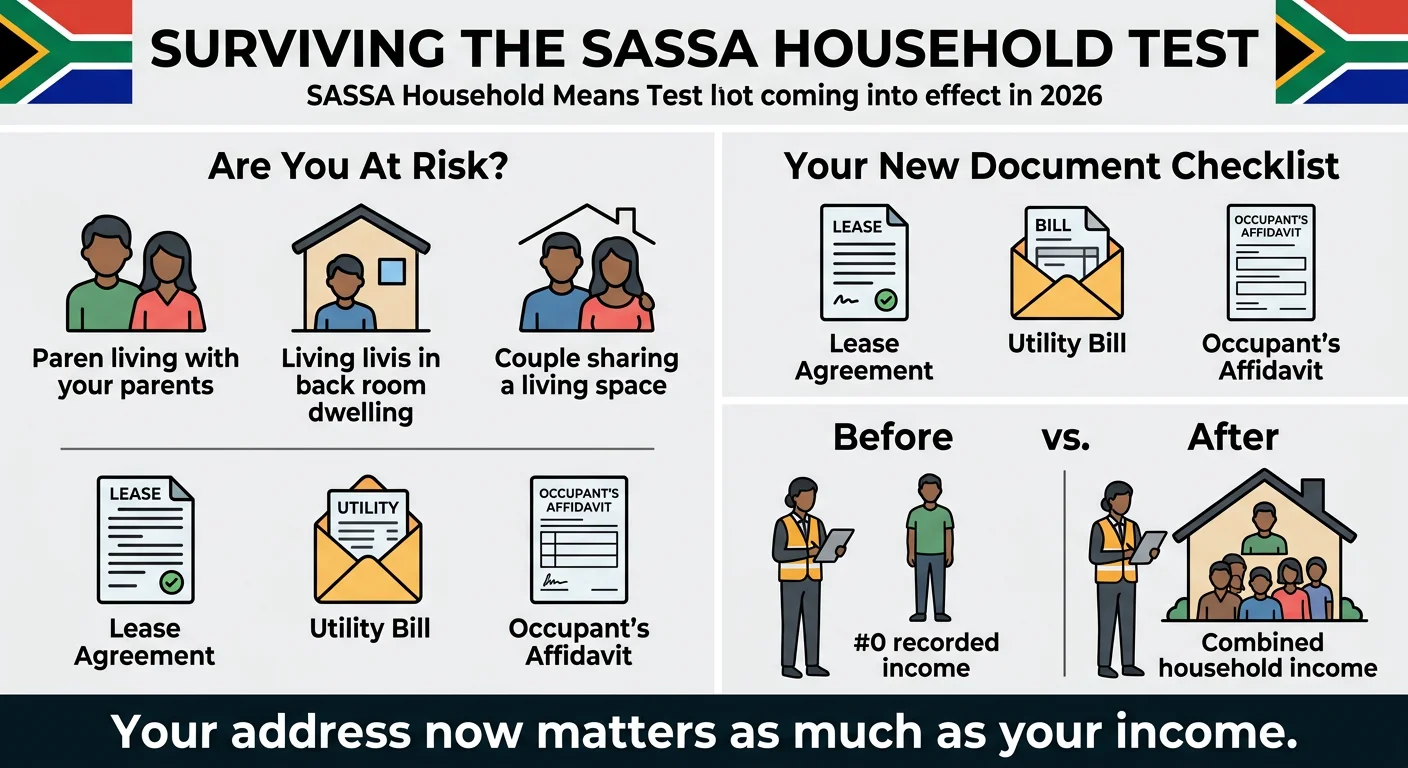
Are You at Risk? Who Will Be Disqualified from 1 May 2026
This new test isn’t going to hit everyone, but if you fall into certain groups, you should be very concerned. From May 1, 2026, your grant is on the line if you are:
- Living with family members who have jobs: If you’re an unemployed adult and your parents or siblings earn a formal salary, SASSA might decide the household is doing “too well” for you to get your R390.
- Staying in a back room or garden cottage: If you rent a space on a property where the main owner has a job, you’ll have to jump through hoops to prove you are financially independent.
- Living with a working partner: You don’t have to be married. If SASSA’s systems link you to someone who earns an income at your address, your grant could be flagged immediately.
- Lacking a formal address: This is the part that makes me angry. If you live in an informal settlement and don’t have a lease or a utility bill in your name, you face a massive hurdle. Without the right paperwork, SASSA might just say no.
This policy feels like it’s punishing the “Ubuntu” system where families help each other survive. To see where you stand before these changes hit, you should definitely keep doing your regular SRD Status Check.
The ‘Proof of Poverty’ Paper Chase: What Documents You’ll Need NOW
The burden of proof has shifted. Now, it’s up to you to prove you’re poor enough to qualify. Starting May 1, 2026, if the system flags you, you’re going to need a paper trail that most people don’t just have lying around. You will likely need one of these:
- A Formal Lease: A signed paper showing you pay rent as a separate tenant.
- A Utility Bill: A municipal account for water or lights that is actually in your name.
- Bank-Verified Proof of Address: A fresh statement from your bank that confirms where you live.
- The New ‘SASSA Occupant’s Affidavit’: This is the government’s “solution” for people without formal papers. It’s a new form that both you and the homeowner have to sign in front of a Commissioner of Oaths. It has to state that you live as a separate, independent household.
These forms should be on the SASSA site by April 2026. I suspect this is going to be a nightmare for the 1.8 million people living in informal settlements who don’t have a “landlord” in the traditional sense.
A Policy Blind to Reality? Why This Will Hurt the Poorest
I’ve been looking at the data, and this policy feels completely out of touch with South Africa in 2026. Our unemployment rate is sitting at 41%. People aren’t living with their relatives because they want to; they’re doing it to survive. This ‘Household Means Test’ feels like it’s penalizing that survival instinct.
Dr. Zola Ndaba from the Institute for Social Justice put it perfectly when he called this an “administrative nightmare.” He’s right. Sharing a roof is not the same as sharing an income. Sometimes family members don’t get along, or they refuse to help each other. Now, the government is assuming that if one person has a job, everyone in the house is fed. It’s a cold, bureaucratic approach to a very human struggle. It might even force families to kick out their unemployed relatives just so those relatives can keep their R390 lifeline.
Your Action Plan: How to Prepare for the May 1st Deadline
The May 1, 2026 deadline is closer than it looks. You cannot afford to wait until your grant is declined to fix this. Here is what I suggest you do right now:
- Be honest about your risk: Look at those categories I mentioned. If you live with someone who works, assume SASSA is going to flag you.
- Start the “paperwork talk” now: Talk to the person you live with. Tell them about the new affidavit. You’re going to need their help and their signature, so make sure they’re on board early.
- Find any proof you have: Even an old retail account statement or a bank letter might help. Start a folder and keep everything together.
- Know your local Commissioner of Oaths: Find out where your nearest police station or post office is. You’ll need them to stamp your affidavit.
- Watch the news like a hawk: We’ll be tracking when that official affidavit form is released in April. If you do get rejected after May 1, don’t give up. You can find the steps to fight back in our Appeals Guide.
Frequently Asked Questions
What exactly is the new SASSA Household Means Test starting in May 2026?
Will I automatically lose my grant if I live with my employed parents?
What can I use as proof of address if I live in a shack or informal settlement?
How is this new test different from the means test SASSA already uses?
Where can I get the new 'SASSA Occupant's Affidavit' form?
If I am unfairly disqualified by this new rule, can I appeal?
Read Next
Eskom's New 'Smart Meter' Debt Clawback: Is 50% of Your R390 SASSA Grant Already Gone in 2026?
BREAKING March 2026: A new government policy enforcing mandatory …
The R390 Stokvel Revolution: How Your SASSA Grant Can Become R2,000 with PayShap in 2026
In March 2026, the R390 SASSA grant barely covers essentials. But a financial …
Comments & Discussions