
Table of Contents
I’ve been looking closely at the SASSA changes planned for April 2026, and it’s clear the government is about to flip the script on the SRD grant. The new R450 ‘Work-for-Grant’ policy isn’t just a small update. It is a total overhaul that ties your monthly support to a mandatory job-seeking contract.
The End of Unconditional Grants: Introducing the R450 ‘SEP’ Grant
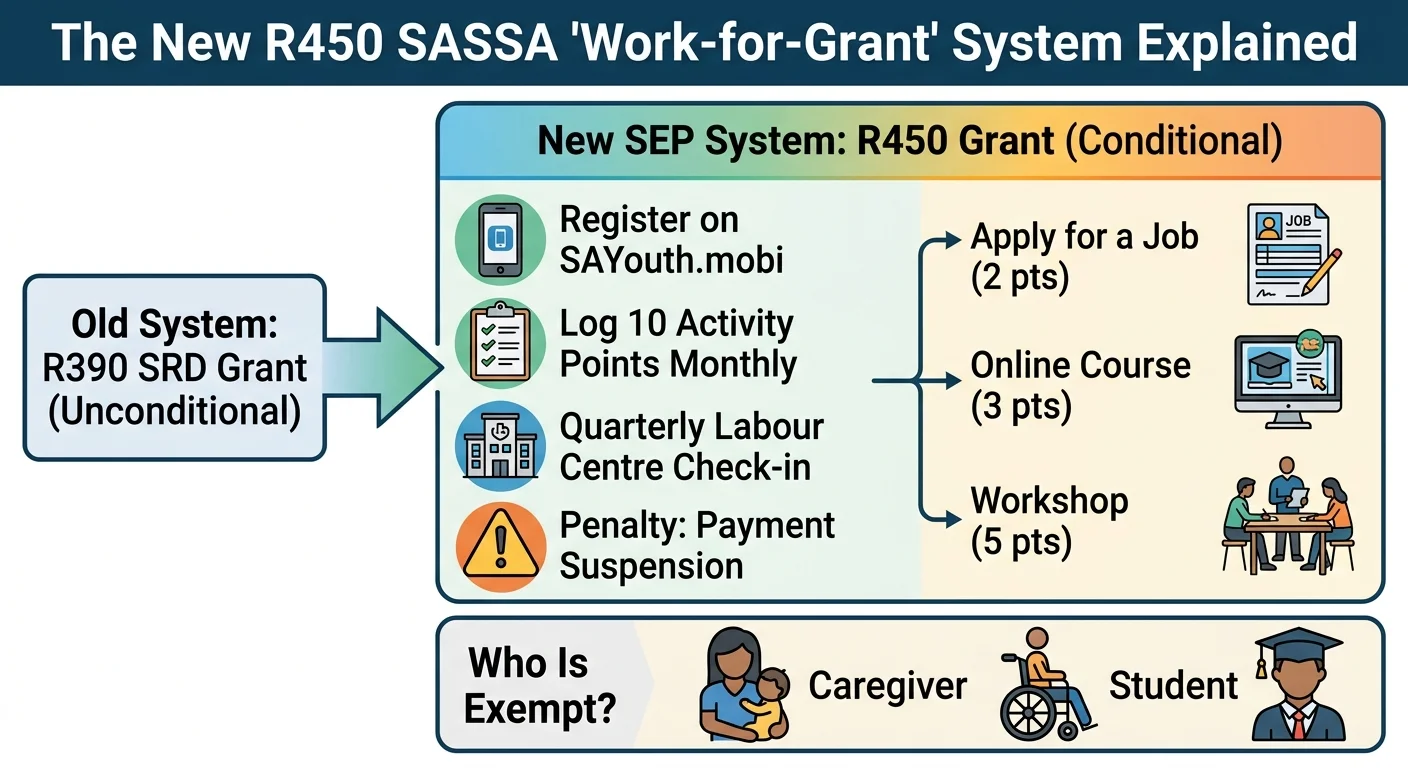
The days of getting the R390 Social Relief of Distress (SRD) grant without any strings attached are coming to an end. A leaked draft policy from the Department of Social Development (DSD), dated 8 April 2026, reveals the ‘Skills & Employment Pathway’ (SEP) initiative. This is set to replace the SRD grant for all able-bodied people by June 2026. While the grant amount goes up to R450, there is a massive catch. Payments are now strictly conditional.
The GNU says they want to move people from being “passive recipients” to “active participants” in the economy. They are pointing to Stats SA data from early 2026 showing youth unemployment at a staggering 63.9% as the reason for this change. For about 7 million of the 8.8 million people currently getting the SRD, the grant is no longer a right. It is something you have to prove you are working for by actively hunting for a job.
How the New ‘Work-for-Grant’ System Will Function in 2026
The new R450 SEP system uses a “points” approach. You have to rack up a certain number of activity points every month or you simply won’t get paid. Everything runs through the ‘MySA Gov’ portal and the SAYouth.mobi platform. Here is how the process looks in the draft policy:
- Automatic Migration: If you are between 18 and 59 and already get the SRD, you’ll be moved to the SEP system automatically. You will have to verify who you are using the new Digital ID system by May 2026.
- The Profile: You must build a full profile on SAYouth.mobi. This means uploading a CV, listing what you can do, and picking career interests.
- Monthly Points: You need at least 10 ‘activity points’ each month. Applying for a verified job earns you 2 points. Finishing an online skills course gets you 3 points. Attending a government workshop is worth 5 points.
- In-Person Meetings: Every three months, you have to show up at a Department of Labour centre or a mobile unit to prove you are making progress.
If you don’t hit those 10 points, your payment for the next month is cut off immediately. This is a massive shift in how the state treats the unemployed, and I expect it to cause a lot of frustration.
The Great Debate: Dignity and Opportunity vs. Punitive Control
This SEP grant has started a huge argument. People in the National Treasury say this is how we break the cycle of “dependency.” One official told me that they are putting an extra R60 into people’s pockets to invest in their future, not just to give them a handout. They point to a test run in Gauteng where 15% of people actually found work within six months.
But I worry about the reality on the ground. The Black Sash has called this policy “punitive,” and I think they have a point. On 9 April 2026, they pointed out that this system basically punishes people for being poor when there are no jobs to be had. If you live in a rural village with no internet and no money for a taxi to get to town, how are you supposed to apply for jobs online? It feels like the government is blaming the individual for a broken economy. A missed payment for someone with nothing is a total disaster. If you feel you’ve been cut off unfairly, you need to know your rights. Our Appeals Guide explains how to fight back against SASSA decisions.
Who is Exempt? Understanding the Fine Print of the SEP Policy
Not everyone on the SRD grant has to jump through these hoops. The draft policy does list some exemptions, though I suspect the paperwork will be a nightmare. Here is who doesn’t have to meet the job-seeking rules:
- Primary Caregivers: If you are the main person looking after a child who gets a Child Support Grant, you are exempt.
- People with Disabilities: If a doctor certifies that you cannot work, you can apply for an exemption, even if you don’t get the full Disability Grant.
- Students: If you are studying full-time at a TVET college or university, you’re in the clear.
- Remote Locations: If you live more than 50km from a Labour centre and have no transport, there is a rule for you, but proving it might be difficult.
You’ll need to apply for these exemptions through the MySA Gov portal. You might need to upload affidavits or medical letters. The DSD thinks about 1.8 million people will be exempt, which leaves 7 million people who have to navigate this new system.
Your 5-Step Action Plan to Secure Your R450 Grant Payment
These changes are coming fast. If you want to keep your money, you need to be ready. Here is what I suggest you do right now:
- Get Your Smart ID: The old green ID books are on their way out. Go to Home Affairs and get a Smart ID Card. You need it for the Digital ID verification.
- Fix Your CV: Don’t wait for the deadline. Go to a library or a community centre and get a simple CV typed up. Save it in your Gmail so you can find it later.
- Check out SAYouth.mobi: Go to the site today. You don’t have to sign up yet, but look around. See how it works so you aren’t confused when the pressure is on.
- Find Your Labour Centre: Figure out where the nearest Department of Labour office is. Work out the taxi fare and the route, because you’ll be going there four times a year.
- Watch the News: Things change. Keep an eye on SASSA announcements. We will keep our Payment Dates page updated with the latest rollout info as soon as it’s official.
Frequently Asked Questions
What happens if I don't get 10 'activity points' in a month?
How can I prove I applied for a job if the company doesn't reply?
Is the R450 SEP grant replacing the SRD grant permanently?
What if I don't have a smartphone or internet access?
Will the SASSA Disability and Child Support Grants be affected?
When does this new R450 grant system start?
Read Next
Green ID Book to Be SCRAPPED: Your 2026 Guide to Getting the New Digital ID to Save Your R390 SASSA Grant
BREAKING April 2026: The Department of Home Affairs has announced the mandatory …
SASSA May 2026 Payments Come EARLY: Get Your R390 Grant Plus New R100 'Freedom Vouchers' at Shoprite & Pick n Pay
BREAKING for April 2026: SASSA has confirmed that May 2026 grant payments will …
Comments & Discussions