

Table of Contents
A deep-dive analysis into the proposed SASSA ‘Progression Pathway’ for 2025. We break down the shift from a universal cash grant to a conditional system involving skills training and work-seeking requirements. Discover the potential benefits, the hidden risks, and what this means for the future of the R350 grant in South Africa.
The Bombshell Proposal: Rethinking the R350 Grant for 2025
The social security landscape in South Africa is poised for its most significant shake-up since the introduction of the Social Relief of Distress (SRD) grant. As of December 2025, government circles and civil society are buzzing with debate over the proposed ‘Progression Pathway’ framework. This isn’t just another incremental increase; it’s a fundamental reimagining of what social support for the unemployed should look like. According to preliminary documents reported by sources like News24 and the Daily Maverick, the proposal aims to move recipients from what is termed ‘passive receipt’ of the R350 grant towards ‘active economic participation’. In plain English, the era of an unconditional cash transfer could be coming to an end, replaced by a system that links financial support to specific requirements like skills training, job searching, and community work. This is a seismic shift, and for the millions who depend on that R350, it raises one critical question: is this a hand up, or a push out?
What is the ‘Progression Pathway’? Unpacking the Government’s Vision
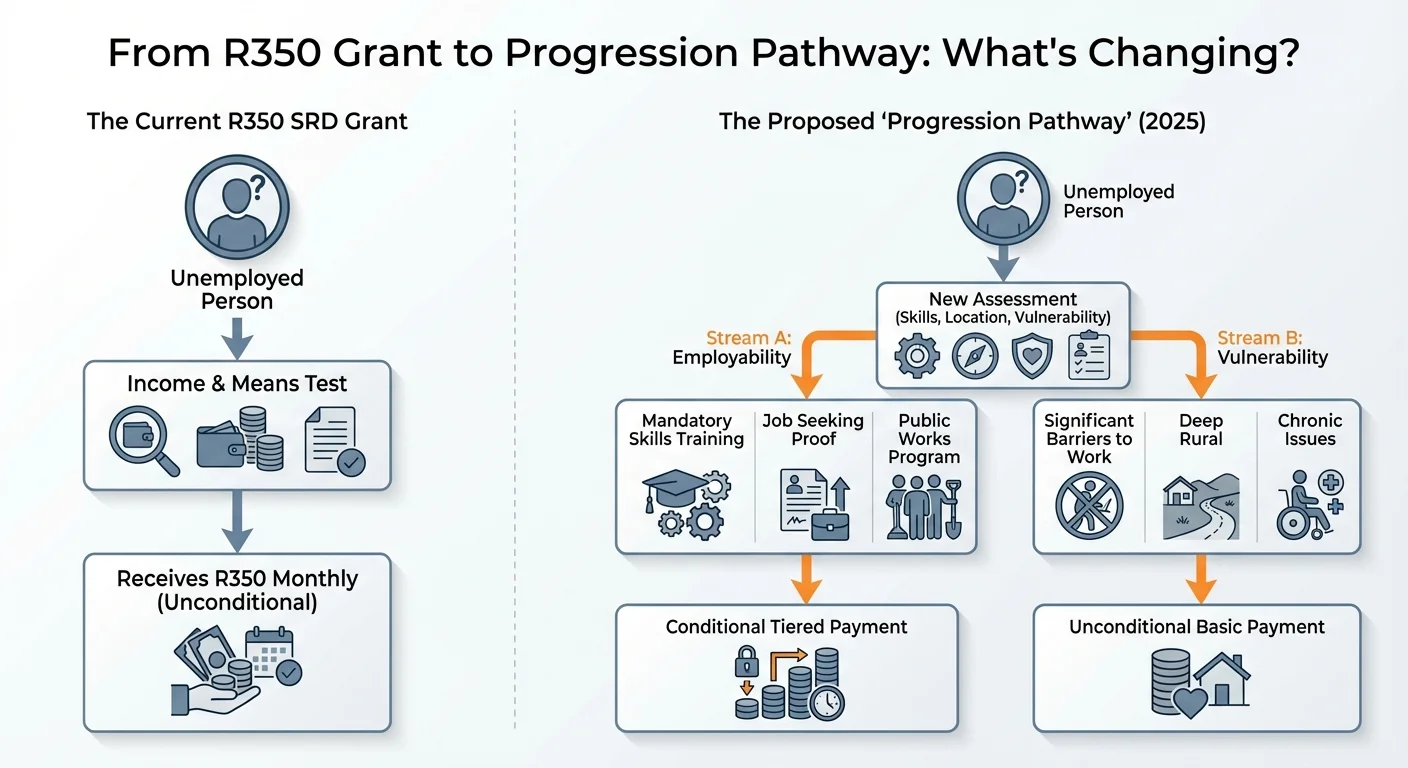
The ‘Progression Pathway’ is a two-stream model designed to differentiate between beneficiaries based on their perceived ability to enter the workforce. Here’s a simplified breakdown of the proposed structure:
Stream 1: The Skills & Employability Stream
- Target Group: Able-bodied individuals between 18 and 59 who are currently unemployed but deemed capable of work.
- The Deal: To continue receiving financial support (potentially a tiered amount, not necessarily R350), individuals in this stream would be required to register with the Department of Labour’s employment database, attend mandatory skills development workshops, or participate in public employment programs.
- The Goal: The stated objective is to equip people with the skills needed to find formal employment, thereby reducing long-term dependency on the state.
Stream 2: The Vulnerability Stream
- Target Group: Individuals who face significant barriers to employment, such as those with disabilities (not covered by the disability grant), those in deep rural areas with no job prospects, or those with other chronic vulnerabilities.
- The Deal: This stream would likely continue to provide an unconditional cash transfer, similar to the current R350 grant, acknowledging that direct employment is not a realistic short-term outcome for this group.
The critical challenge, of course, lies in the assessment. Who decides which stream a person belongs to? What criteria will be used? The potential for bureaucratic errors and unfair exclusions is immense, a point that critics have been quick to raise.
The Argument For: A Path Away from Dependency?
Proponents of the ‘Progression Pathway’, primarily within the National Treasury and the Department of Social Development, argue that the current R350 grant, while a crucial poverty-alleviation tool, was never intended to be a permanent solution. Their argument rests on several key pillars:
- Fiscal Sustainability: The cost of the SRD grant is enormous. Linking it to economic activity is seen as a way to manage long-term costs and ensure the social security net doesn’t collapse under its own weight.
- Combating the ‘Poverty Trap’: The theory is that an unconditional grant, while essential for survival, can create a disincentive to seek low-paying or informal work. By adding conditions, the government hopes to nudge people towards formal employment.
- Human Capital Development: South Africa has a massive skills gap. Proponents argue this policy could be a vehicle to deliver mass-scale vocational training, creating a more skilled workforce that can contribute to economic growth.
From this perspective, the policy is not a punishment, but an investment in the country’s human potential. It’s an optimistic vision, but one that rests on a huge number of ‘ifs’.
The Argument Against: A Recipe for Disaster?
Civil society organizations and welfare rights groups have sounded the alarm, warning that the ‘Progression Pathway’ could be a humanitarian disaster in the making. Their criticisms are sharp and deeply concerning:
- Lack of State Capacity: Does the government have the infrastructure to provide meaningful skills training to millions of people? Are there enough public works programs? Critics point to past failures in similar schemes as evidence that the state is not ready for a project of this magnitude.
- Punishing the Poor: The core of the criticism is that this policy punishes people for being unemployed in an economy that is not creating enough jobs. If you require someone to search for a job that doesn’t exist, are you helping them or setting them up for failure and exclusion?
- Bureaucratic Nightmare: The assessment process to stream millions of people is fraught with peril. It could lead to mass, unjust exclusions for those who fail to navigate the complex administrative hurdles. For updates on how to handle potential disputes, our guide on SASSA appeals provides essential information that may become even more critical under a new system.
Our Analysis: Good Intentions, Dangerous Assumptions
Here’s our take: The intention behind the ‘Progression Pathway’ is understandable. No one wants to see millions of South Africans reliant on a small grant indefinitely. However, the policy is built on a dangerous assumption: that the primary barrier to employment is a lack of skills or motivation on the part of the unemployed. It largely ignores the structural reality of the South African economy—one of the most unequal in the world, with chronically high unemployment.
Putting the onus on the individual to ‘skill up’ for a job market that isn’t hiring is a flawed premise. Before implementing such conditions, the government must first demonstrate its ability to create jobs and provide high-quality, relevant training. Without that, the ‘Progression Pathway’ risks becoming a ‘Pathway to Exclusion’, where millions are cut off from their only lifeline due to their inability to meet conditions that are beyond their control. It’s a classic case of putting the cart before the horse.
What This Means for You, the R350 Beneficiary
If this policy is implemented in 2025, your relationship with SASSA will change dramatically. Here’s what you need to prepare for:
- More Admin: You may be required to regularly check in at labour centres, submit proof of job applications, or enroll in specific programs.
- Re-assessment: Your eligibility won’t just be about your income. SASSA will likely need to assess your skills, location, and ’employability’ to place you in a stream.
- Uncertain Payments: Your grant could become conditional. Failure to meet a requirement, even for a legitimate reason, could lead to a suspension of your payment. It is crucial to constantly monitor your application. You can always use the official SRD Status Check tool to stay informed.
- Travel and Data Costs: Meeting these new requirements will cost money—money that R350 beneficiaries do not have. Transport to training centres and data to apply for jobs online are significant new burdens.
The Timeline: What to Expect in Early 2025
As of December 2025, the ‘Progression Pathway’ is still a proposal under intense debate. It has not been signed into law. Here’s the likely path forward:
- December 2025 - January 2025: Public comment period and parliamentary portfolio committee hearings. This is where civil society and the public can voice their opinions.
- February 2025: The proposal will be a major topic during the National Budget speech. The funding allocated will be the biggest indicator of the government’s true commitment.
- March - June 2025: If approved, expect a phased rollout, likely starting with pilot programs in certain provinces.
For now, the current R350 SRD grant system remains in place. Keep an eye on the official SASSA payment dates as they are announced for the coming months.
Conclusion: A Crossroads for South Africa’s Social Compact
The debate over the ‘Progression Pathway’ is more than just a policy discussion; it’s a reflection on the kind of society South Africa wants to be. Do we see social grants as a temporary handout to be removed as quickly as possible, or as a fundamental investment in the dignity and stability of our people? While the goal of economic empowerment is noble, the proposed method is deeply flawed and risks hurting the most vulnerable. Unless the government can first fix the economy and its own administrative capacity, this pathway could lead millions of South Africans not to progression, but to destitution.
Frequently Asked Questions
What is the new SASSA 'Progression Pathway' policy being discussed for 2025?
Will my R350 grant be stopped in 2025 because of this new policy?
When is the 'Progression Pathway' expected to start?
What kind of skills training will SASSA offer under the new system?
How will SASSA decide if I am 'employable' or 'vulnerable'?
What happens if I can't meet the new job-seeking requirements?
Is this new policy a replacement for the Basic Income Grant (BIG)?
Where can I get official information on SASSA policy changes?
Do I need to re-apply for my grant now because of this news?
How can I voice my opinion on this proposed policy?
Read Next
SASSA's New 'Mandatory App' Locks Your R390 Grant? The 2026 Guide for Beneficiaries Without a Smartphone
BREAKING April 2026: SASSA is rolling out a mandatory new smartphone app, …
The R140 Paraffin Price SHOCK: How 40% of Your R390 SASSA Grant Will Vanish on May 1st, 2026
BREAKING April 2026: NERSA has approved a devastating 40% increase in the price …
Comments & Discussions