
Table of Contents
Title: SASSA’s R1.2 Billion Corruption Scandal: Your R390 Grant Safe? New ‘Anti-Corruption Dashboard’ for 2026 Revealed
I’ve been looking into the new anti-corruption policies being fast-tracked by SASSA and the Department of Social Development this April 2026, and frankly, it’s about time. Between the new ‘Anti-Corruption Dashboard’ and the promised ‘Beneficiary Bill of Rights,’ there is a lot to unpack regarding how the government plans to protect your R390 grant from the kind of fraud revealed in the latest SIU scandal.
The R1.2 Billion Bombshell: How a New SIU Report Shook SASSA to its Core
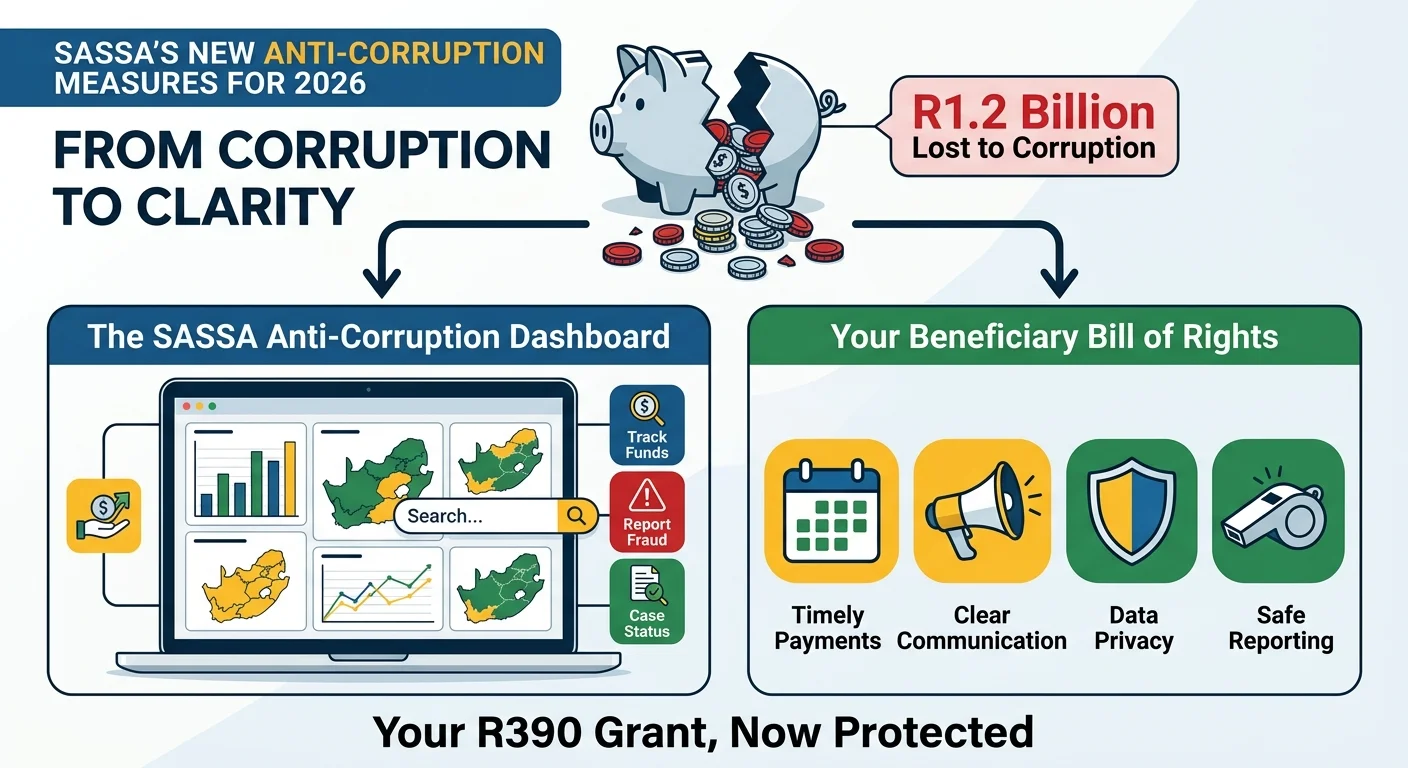
South Africa was hit with some ugly news in early April 2026. An explosive Special Investigating Unit (SIU) report alleged that a massive R1.2 billion in social relief funds has been systematically looted. According to the summary published by TimesLive, this corruption mostly hit emergency relief budgets meant for disaster victims over the last 18 months. It’s the kind of news that makes you lose faith in the system.
For the 8.5 million people waiting on their R390 SRD grant, this isn’t just some distant political headline. It feels like a direct threat. The report claims that nearly 30% of the emergency budget for the 2025 KZN floods vanished into the pockets of syndicates and dirty officials. That’s money that should have helped 500,000 people. I keep thinking: if they can steal disaster funds that easily, how safe is the R390 grant? The public anger has finally pushed the Government of National Unity (GNU) and the Department of Social Development (DSD) to act. They know that if they don’t fix this now, people will stop believing in SASSA entirely.
URGENT RESPONSE: The New ‘SASSA Anti-Corruption Dashboard’ Explained
The SASSA Anti-Corruption Dashboard is the government’s big answer to the mess. Announced on April 2, 2026, this public website is supposed to show exactly how grant money moves in real-time. During a DSD press briefing, officials said the dashboard will include interactive maps showing where money goes by province, data on fraud cases, and how well the agency is actually doing at stopping thieves.
The idea is to stop hiding behind closed doors and let the public see the books. The dashboard will track funds from the National Treasury all the way to the people paying out the money. If a pattern looks suspicious, it should flag it for everyone to see. As a beneficiary, you’ll supposedly be able to check how many grants are paid in your district and see if fraud is being caught or ignored. This is a huge shift in how SASSA operates. They’ve always had internal audits, but those haven’t stopped the looting. Letting the public look inside is a move that I think is way past due.
Your New Power: Unpacking the 2026 ‘Beneficiary Bill of Rights’
Along with the new tech, the DSD is proposing a ‘Beneficiary Bill of Rights’ to give grant recipients some actual legal teeth. This isn’t just another boring document; it’s meant to be a charter you can use to hold SASSA’s feet to the fire. The draft should be out for public comment by May 2026, and it covers some vital ground.
First, there is the Right to Timely Payment. This would legally require SASSA to pay on specific dates, with actual penalties if they mess up. For the most recent schedule, you can check our Payment Dates page. Then there is the Right to Clear Communication. I’m tired of seeing people stuck with a ‘Pending’ status for months with no reason why. This rule would force SASSA to explain exactly why a grant was rejected or delayed.
The Bill also includes the Right to Data Privacy, so your info isn’t sold or leaked, and the Right to a Fraud-Free Payment System. This puts the blame on SASSA and the banks if scammers steal your money through illegal debit orders. And finally, there is a Right to Safe & Anonymous Whistleblowing. You should be able to report a corrupt official without worrying that your own grant will be cut off as a punishment.
Will This Actually Work? A Critical Analysis of the New Anti-Fraud Policies
I want to believe these changes will work, but I have my doubts. A public dashboard is great, but it can easily become “transparency theatre” if the data is old or incomplete. The biggest hurdle is getting honest information from over 900 local SASSA offices.
Dr. Thandi Mkhize from the Wits School of Governance put it well: “A dashboard is only as good as the data it receives. The real fight is closing the systemic loopholes that allow for corruption in the first place.” She’s right. A Bill of Rights is just a piece of paper unless there is an independent person—like an ombudsman—who can actually punish SASSA when they fail. We’ll see if the GNU actually puts the money and political muscle behind this, or if it’s just a way to quiet the public after a billion-rand scandal.
How to Use the New System and Report Fraud Safely in April 2026
While we wait for these new systems to go live, you have to stay sharp. The new policies promise safer ways to speak up, but you can take action right now.
Step 1: Use Official Channels Only. Don’t try to report fraud on Facebook or WhatsApp. The only real SASSA Anti-Corruption Hotline is 0800 60 10 11. If someone messed with your SASSA/Postbank card, call the Postbank Fraud line at 0800 53 54 55.
Step 2: Get Your Facts Straight. Before you call, write everything down. What happened? When? Who was involved? Keep your reference numbers handy. It makes it much harder for them to ignore you if you have a clear paper trail.
Step 3: Stand Your Ground. Even if the ‘Bill of Rights’ isn’t law yet, act like it is. If your grant is suspended for no reason, demand a clear answer. You have a right to challenge their decisions. If you need help with that, look at our Appeals Guide. Once the dashboard is live, it will be easier to track these issues, but for now, your best defense is keeping your own records and staying loud.
Frequently Asked Questions
What is the new SASSA Anti-Corruption Dashboard?
Is my R390 SRD grant at risk because of this R1.2 billion corruption scandal?
When will the new dashboard and Bill of Rights be active?
How can I report SASSA-related fraud right now in April 2026?
What key protections will the Beneficiary Bill of Rights give me?
Does this massive corruption mean the government will stop SASSA grants?
Read Next
Goodbye R390 SRD? The GNU's New 'Points-Based' SASSA Grant for 2026 Explained
BREAKING for April 2026: The Government of National Unity (GNU) has just …
NHI Goes Live in 2026: Is a Hidden 'Health Tax' Coming for Your R390 SASSA Grant?
BREAKING NEWS for March 2026: The National Health Insurance (NHI) is officially …
Comments & Discussions