Table of Contents
Title: SASSA’s R370 ‘Work-for-Grant’ Scheme for 2026: The End of ‘Money for Nothing’?
We’re looking at a massive shift for January 2026. The Department of Social Development is talking about tying the R370 SASSA grant to mandatory community work or skills training. I’ve been looking into this ‘Active Citizen Programme’ and the government’s arguments for it, and frankly, the criticism from civil society is loud for a reason. This could change everything for millions of SASSA beneficiaries.
The Bombshell Proposal: Is the Unconditional R370 Grant Disappearing in 2026?
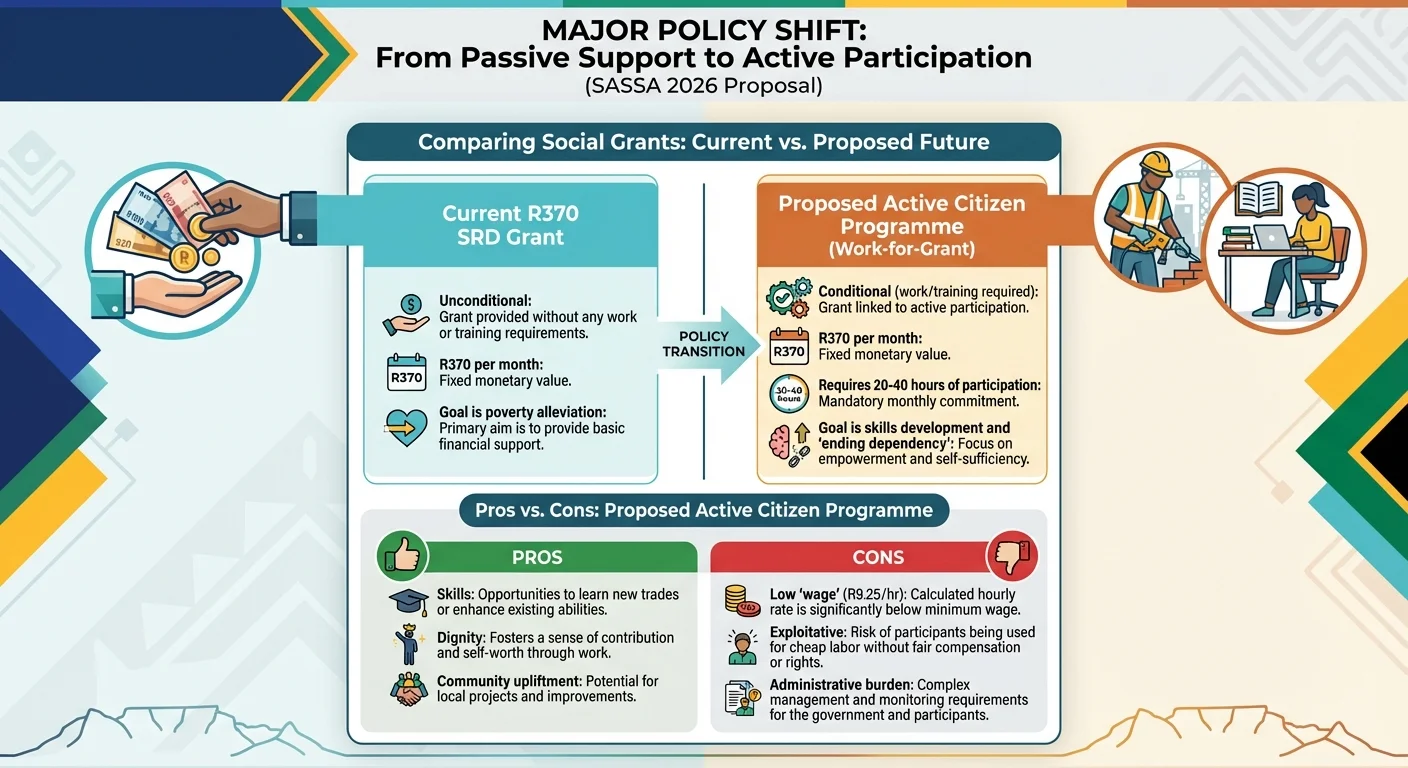
Millions of South Africans rely on the R370 Social Relief of Distress (SRD) grant just to put bread on the table. Now, the ground is shifting. In late January 2026, reports from parliamentary briefings revealed a plan that would flip the whole system on its head. The ‘Active Citizen Programme’ wants to stop handing out cash with no strings attached. Instead, if you want your R370, you might have to do community service or sit through training sessions.
This is a huge deal. The SRD grant started during the COVID-19 pandemic as a simple safety net. Tying it to labor feels like a total change in how the state views the poor. I think it’s fair to ask: is this actually about helping people get jobs, or is it just a way to get cheap labor out of the most desperate people in the country? For the folks whose survival depends on this money, the news isn’t just a policy update. It’s a massive source of stress.
Unpacking the ‘Active Citizen Programme’: What Would ‘Work-for-Grant’ Involve?
We don’t have every single detail yet, but people close to the Department of Social Development are starting to talk. The plan is to link your R370 grant to a set number of hours. I’ve heard rumors of 20 to 40 hours a month of ‘active participation.’ What that actually looks like depends on where you live.
Potential Activities Include:
- Community Service: You might be asked to clean streets, work in a local food garden, help out at community halls, or do basic maintenance on public buildings.
- Skills Training: This involves attending short courses. They’re looking at things like basic computer skills, managing money, or vocational training like sewing or plumbing. The idea is to give you something to put on a CV.
- Job-Seeking Activities: You might have to prove you’re actually looking for work. This could mean signing up for government databases, going to career fairs, or showing that you’ve sent out a certain number of applications.
The logistics here look like a nightmare. The program would run at a municipal level, and I honestly wonder who is going to manage all this. Who buys the tools? Who supervises the work? If you live in a tiny rural village with no projects nearby, do you just lose your grant? These are the real-world problems the government hasn’t solved yet. If you’re currently getting the grant, you should check out our complete SRD grant application guide to see how things work right now.
The Government’s Case: A Pathway to Dignity and Economic Activity?
The people in the Government of National Unity (GNU) pushing this are trying to sell it as a “hand up.” They talk a lot about dignity. They argue that working for the money gives people a sense of purpose and self-worth that a “handout” doesn’t.
They’re also focusing heavily on the youth unemployment crisis. By forcing people into training, they hope to turn the SRD grant into a “trampoline” that bounces people into the real economy. It sounds good on paper.
Then there’s the talk about “dependency.” There is a growing group in government that worries South Africans are becoming too reliant on the state. They want the ‘Active Citizen Programme’ to be a nudge toward self-reliance. They want the grant to be a last resort, not a permanent lifestyle.
The Backlash: Is This Exploitation and an Attack on the Poor?
The pushback has been immediate and, in my opinion, totally justified. Activists and unions are calling this state-sanctioned exploitation. Do the math: if you work 40 hours a month for R370, you’re earning about R9.25 an hour. The national minimum wage is over R27. That’s not a “stipend”—it’s a slave wage.
I also worry about the people who physically can’t do this. What happens to the person with a chronic illness or the mother who has no one to watch her kids while she’s out cleaning streets for R9 an hour? It feels cruel to make people “perform” their poverty just to get a tiny bit of help. Critics are worried this is just a way to kick people off the system by making the rules too hard to follow. If you’re worried about your grant being stopped, make sure you understand the appeals process.
Global Context and Local Reality: Is This Different from EPWP?
Other countries like Brazil have done things like this, but usually, they ask you to send your kids to school or get health check-ups. South Africa is asking for labor, which is much more controversial. We already have the Expanded Public Works Programme (EPWP), so why do we need this?
The difference is the money. EPWP is a job. It pays a daily wage that is much higher than the R370 grant. This new plan isn’t a job. It’s a condition. You aren’t being hired; you’re being told to work or you won’t eat. That distinction is huge. It blurs the line between helping people and forcing them into sub-minimum wage labor. It’s a path South Africa hasn’t walked before, and I think it’s going to lead to some serious court battles.
What This Means For You and Your R370 Grant in 2026
Right now, this is still just a proposal. It isn’t law yet, and there is going to be a massive fight in Parliament before it ever happens. But you need to keep your eyes open. If this goes through, you’ll likely have to register at your local muni and keep a paper trail of everything you do to keep your money flowing.
The days of an unconditional Basic Income Grant feel further away than ever. My advice is to stay informed and watch for any official word from SASSA. Keep an eye on the SASSA payment dates page for any updates. We’re heading into a very different era for social grants in South Africa, and you’ll need to be ready to adapt if this becomes reality in late 2026.
Frequently Asked Questions
Is the SASSA 'work-for-grant' scheme official policy in 2026?
If this passes, will every SRD grant recipient have to work?
What kind of work would be required for the R370 grant?
Is it legal to make people work for R370 a month?
How is this 'Active Citizen Programme' different from the EPWP?
What if I physically cannot work or have to care for my children?
When could this new SASSA policy start?
Where can I find official information on this proposal?
Read Next
SASSA's R10 'Khulisa Account': Your Guide to the New Low-Cost Bank Account for 2026
BREAKING March 2026: The South African Reserve Bank has mandated a new …
The R80 Chicken Apocalypse: How Avian Flu Will Steal Over R100 of Your R390 SASSA Grant in April 2026
BREAKING March 2026: A catastrophic Avian Flu outbreak is set to decimate South …
Comments & Discussions