

Table of Contents
A comprehensive analysis of the socio-economic impact of SASSA grants in South Africa as of December 2025. We investigate the arguments for grants as a vital poverty alleviation tool versus the concerns of creating a dependency culture. This article provides a thought-provoking perspective on the future of social security and what needs to change.
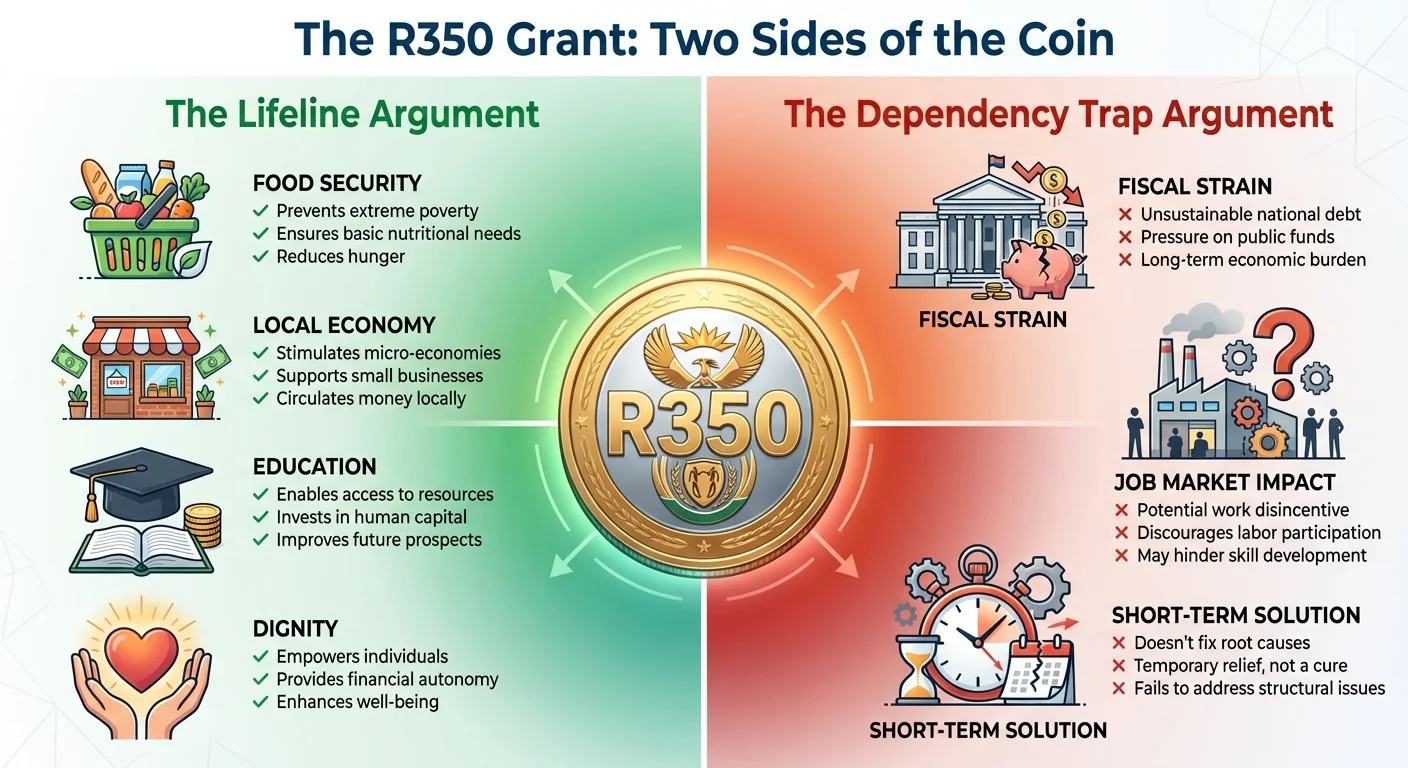
The Uncomfortable Question Everyone Is Asking in December 2025
As millions of South Africans check their SASSA status for the final payments of 2025, a polarising debate echoes from the queues at ATMs to the halls of Parliament: Is the R350 Social Relief of Distress (SRD) grant a life-saving miracle or a slow-acting poison for the nation’s economic future? For years, this grant has been extended, debated, and relied upon. Now, in December 2025, with unemployment statistics remaining stubbornly high, we can no longer avoid the question. This isn’t just about a payment; it’s about the soul of our social contract and the future we are building for the next generation.
Argument 1: The Grant as an Undeniable Lifeline
Let’s be unequivocally clear: for millions, the SASSA grant is not a luxury, it’s the sole barrier against starvation. Proponents argue that viewing the grant through a purely economic lens is a disservice to human dignity. In thousands of communities, that R350, meager as it is, is what fuels the local ecosystem. It’s the money that buys bread from the spaza shop, pays for a taxi to a job interview, or purchases data to apply for work online. Reports throughout 2025 continue to highlight that this money is a critical economic stimulus at the micro-level, preventing a total collapse in the most vulnerable households. To remove it without a viable alternative would be to plunge millions into a state of absolute desperation. It’s the difference between a child going to school with food in their stomach or not.
Argument 2: The Whispers of a Dependency Trap
On the other side of the debate are the growing concerns about fiscal sustainability and the creation of a ‘dependency culture’. Critics, often from business and economic sectors, argue that the grant, initially a temporary measure, has become a permanent fixture that the national fiscus cannot sustain indefinitely. The core of their argument is that while the grant provides immediate relief, it does little to address the root cause of poverty: a lack of jobs and skills. The fear is that a generation may become accustomed to receiving state support without seeing a clear pathway to economic participation. They ask a tough question: Does the R350 grant, over time, disincentivize the search for entry-level work, especially when transport costs can consume a significant portion of a potential low-end salary?
My Analysis: The Real Failure Isn’t the Grant, It’s the Lack of an Exit Ramp
Framing this as a simple ’lifeline vs. trap’ debate is where we fail. The grant itself is not the problem; it is a necessary, if imperfect, response to a catastrophic market failure. The real crisis, the one we are failing to address in 2025, is the absence of an ’exit ramp’. We have built a system that is excellent at providing basic survival but terrible at creating pathways to prosperity. Where are the programs that link grant recipients to skills training? Where is the support for turning that R350 into a micro-enterprise? A successful social security system shouldn’t just keep people alive; it should empower them to thrive. Right now, our system is a waiting room with no door to the outside world. Beneficiaries aren’t lazy; they’re stuck. If you’re struggling just to get by, you can find the latest SASSA Payment Dates to plan your budget, but planning for the future feels impossible.
The Fiscal Cliff: Can South Africa Afford This Forever?
The numbers don’t lie. The cost of social grants represents a significant and growing portion of the national budget. In 2025, the Treasury has continued to voice concerns over the long-term affordability of the SRD grant in its current form. This financial pressure forces a difficult conversation. Every rand spent on grants is a rand that cannot be spent on infrastructure, education, or creating an environment for job growth—the very things that could provide a long-term solution. This creates a vicious cycle: high unemployment necessitates grants, and the high cost of grants limits investment in job creation.
Beyond R350: What Should a 2026 Solution Look Like?
Continuing the status quo is not a strategy. As we look towards 2026, the discussion must evolve. Here are the alternatives that need serious consideration:
- Conditional Grants: Linking grant payments to participation in skills development programs, community work, or educational courses.
- Enterprise Support: Actively funding and mentoring grant recipients who want to start small businesses. Imagine a ‘Business-in-a-Box’ kit provided alongside the grant.
- A Stepped Approach: A system where the grant amount slowly tapers off as a person begins to earn an income, avoiding the ‘benefits cliff’ where taking a job means losing all support instantly.
- Universal Basic Income Grant (UBIG): A more radical, comprehensive approach that provides a basic income to all, simplifying administration and removing the stigma. However, the fiscal implications are immense and hotly debated.
The Human Cost of System Failures
While policymakers debate, real people suffer from the system’s inefficiencies. Every month, thousands of legitimate applicants find their status ‘Pending’ for no clear reason, or are unfairly declined. This uncertainty is a source of immense stress. The process of challenging these decisions is often overwhelming for the most vulnerable. For those who find their application rejected, our SASSA Appeals Guide provides essential steps, but it’s a process that shouldn’t be this difficult in the first place.
What You Can Do NOW While the Debate Rages On
Waiting for policy change is not an option for most. The key is to view the R350 not as an income, but as a tool. Here are strategies people are using in 2025:
- Pool Resources: In many communities, families and neighbours are pooling their grants to buy goods in bulk, saving money.
- Invest in Data: Using a portion of the grant to buy data to access online courses (many are free), job portals, and information.
- The ‘Stokvel’ Model: Using the grant as seed capital for informal savings clubs that can fund larger purchases or a small business venture.
- Stay Informed: Regularly perform a SRD Status Check to ensure your grant is secure and there are no unexpected issues with your application.
Conclusion: A Crossroads for South Africa
The SASSA grant system, especially the SRD, has brought South Africa to a critical crossroads in December 2025. It is both a monumental achievement in social protection and a stark reminder of our deep-seated economic failures. The grant is not the villain of this story. The true villain is a lack of imagination and political will to build a ladder out of poverty, not just a floor to catch those who fall. As we enter 2026, the question we must answer is not whether to keep the grant, but how we transform it from a permanent safety net into a temporary springboard.
Frequently Asked Questions
Is the SASSA R350 grant a permanent grant in 2025?
What are the main arguments against continuing the R350 grant?
How does the SASSA grant actually help the economy?
Will the SASSA grant amount increase in 2026?
What is a 'benefits cliff' and how does it relate to SASSA?
Are there any proposals to link SASSA grants to work or training?
Why do so many SASSA applications get declined or stuck on 'pending'?
What is the difference between the SRD grant and a Universal Basic Income Grant (UBIG)?
Read Next
Home Affairs ID Crisis 2026: Your R390 SASSA Grant Now Blocked? Your Emergency Plan
BREAKING March 2026: A catastrophic system failure at the Department of Home …
Stage 8 Blackout: Your March 2026 SASSA R390 Payment is Trapped. The Ultimate Survival Guide.
BREAKING March 2026: Eskom has plunged South Africa into an unprecedented Stage …
Comments & Discussions