
Table of Contents
Title: R390 Grant BLOCKER: Your 2026 Guide to FNB, Capitec & Standard Bank’s New ‘Voice ID’ Security
Starting in May 2026, South Africa’s biggest banks are changing the rules for everyone. If you receive a SASSA R390 grant, you need to know about mandatory ‘Voice ID.’ This security update could easily block your access to your money if you aren’t prepared. My 2026 guide explains how to set it up, how to handle background noise, and what to do if you don’t own a smartphone.
The ‘Voice ID’ Mandate: What Is It and Why It’s a Hurdle for SASSA Grants?
The new mandatory ‘Voice ID’ is a biometric security tool that FNB, Capitec, and Standard Bank are rolling out in mid-2026. The goal is to stop the digital fraud that is currently stripping millions from South Africans. Instead of just typing a PIN, your banking app will ask you to record your voice saying a specific phrase.
The South African Banking Risk Information Centre (SABRIC) reported that digital fraud cost us over R700 million in 2025, so the banks are desperate to fix it. But here is what worries me: this creates a massive barrier for SASSA beneficiaries. If you can’t get the recording right, the bank might freeze your account, and you won’t be able to touch your R390 grant.
This is going to be a nightmare for anyone living in a noisy environment, like a crowded home or an informal settlement. It’s also a huge problem for the elderly or those with speech impediments. This isn’t a change coming from SASSA, but it is a banking change that hits grant recipients the hardest.
Your Step-by-Step Guide: Secure Your Grant by Setting Up Voice ID
You have to set up your Voice ID to make sure you can actually get to your R390 grant when you need it. The process takes about five minutes, but you need a steady internet connection.
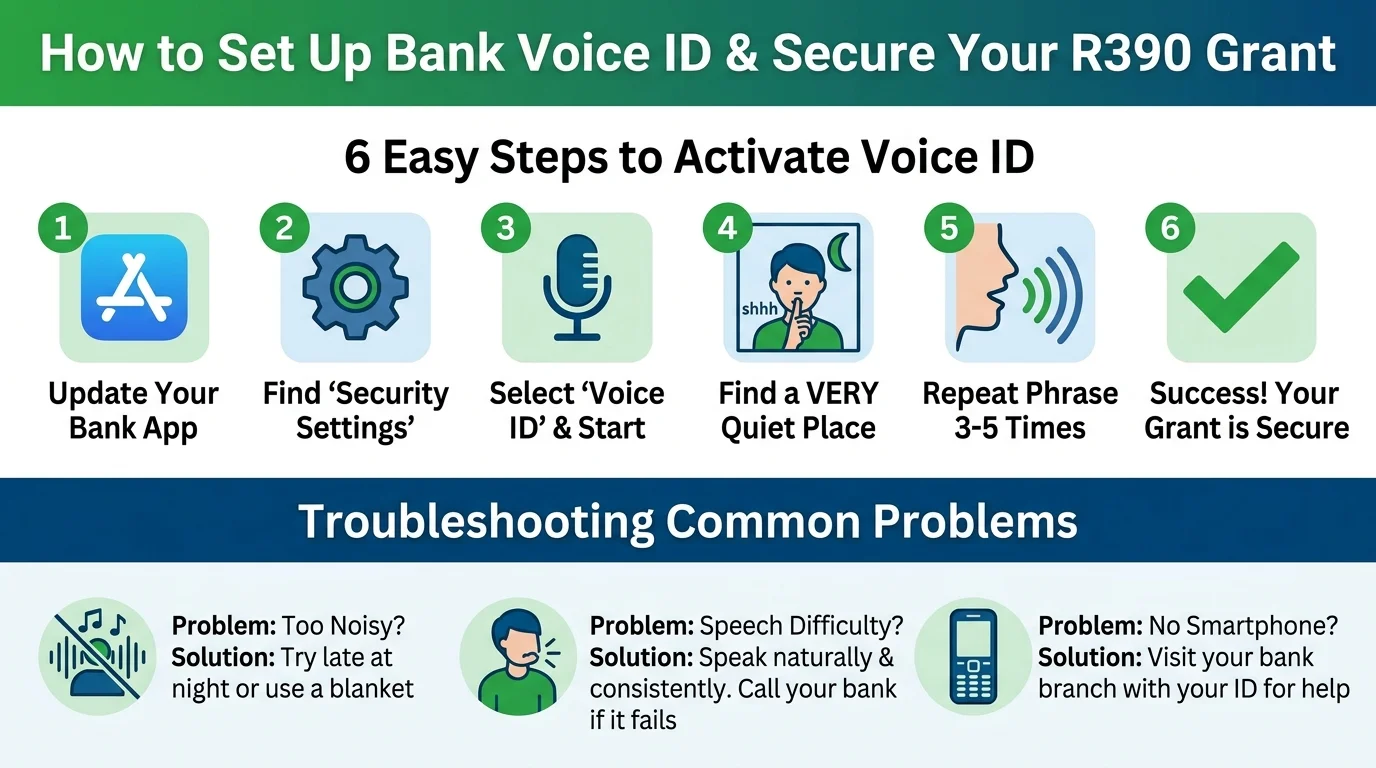
Step 1: Update Your Banking App Go to the Google Play Store or Apple App Store first. Make sure you have the newest version of the FNB, Capitec, or Standard Bank app. The Voice ID option won’t even show up on an old version.
Step 2: Find the Security Settings Open the app and log in. Look under ‘Profile’ or ‘Security.’ You should see something called ‘Voice ID’ or ‘Voice Biometrics.’ Most banks are putting a big notice on the screen to help you find it.
Step 3: Find a Quiet Location This is the part where most people fail. Background noise will ruin the recording. Go into a small room, sit in a car, or even put a thick blanket over your head and the phone. You need to block out the sound of traffic, TVs, and other people.
Step 4: Begin the Recording Process The app will show you a phrase, like “My voice is my password.” Hold the phone about 15cm from your face and say it clearly. Speak like you are talking to a friend. Don’t shout and don’t whisper. You will probably have to say it three or four times so the system learns your voice.
Step 5: Confirmation Once the system is happy, you’ll get a confirmation message. Now your Voice ID is active. The next time you try to pay someone or change your details, the app will ask you to say that phrase to prove it’s really you.
If your grant money isn’t showing up after this update, you should check the official SRD R350 Status Check to make sure SASSA actually sent the payment.
Troubleshooting Common Problems: Noisy Homes, Speech Issues, and Data Costs
I know that setting this up in the real world isn’t always as easy as the banks claim. Here is how to deal with the most common headaches.
Problem: My home is too noisy. Solution: Try doing it late at night or very early in the morning when everyone else is asleep. A closet or a parked car is actually a great place to get some silence. Don’t try to do this at a clinic or a taxi rank because the noise will cause the system to reject your voice.
Problem: I have a stutter or speech impediment. Solution: These systems are built to recognize your specific way of talking. The secret is to be consistent. Say the phrase the same way every time. If the app keeps failing, call the bank’s support line. They are legally required to give you another way to verify your identity, though you might have to go into a branch.
Problem: I am worried about data costs. Solution: Setting this up uses very little data, usually less than 5MB. That’s less than a single 30-second voice note on WhatsApp. If you are out of data, try to find a government Wi-Fi hotspot or a library with free internet.
AdvertisementProblem: My voice is different because I have a cold. Solution: Wait until you feel better. If you already set it up and then get a sore throat, the app might not recognize you. Usually, after three fails, the app will let you use your PIN or a password as a backup so you aren’t stuck.
What If I Don’t Have a Smartphone? Your Alternatives for Voice ID
I keep thinking about the 30% of SASSA beneficiaries who still use basic feature phones. You can’t use an app for Voice ID, but the banks still have to let you access your money.
If you don’t have a smartphone, you have two real choices:
In-Branch Assistance: This is your best bet. Go to your nearest Capitec or FNB branch with your green ID book or Smart ID. Tell the consultant you need to set up Voice ID but you don’t have a smartphone. They will help you do it in person. This usually links your voice to their telephone banking system instead of an app.
USSD and Telephonic Banking: Some banks are letting people enroll over the phone. You might need to dial a code like
*120*321#and follow the prompts. The bank might then call you back to record your voice over the line. Always check your bank’s official website or SMS messages to make sure you are using the right number.
Whatever you do, never ask a stranger to help you set this up on their phone. Your grant is linked to your identity. If you let someone else record their voice for your account, they can steal your money.
Expert Analysis: Is This Security Push Leaving the Vulnerable Behind?
Banks say Voice ID is a great step forward, but I think it risks leaving the most vulnerable South Africans behind. It feels like a solution made for people in fancy offices, not for people living in the reality of our country.
Dr. Nomvula Zondi, an analyst at Stellenbosch University, points out that forcing people to use advanced tech without a proper education campaign is a mistake. For someone in a rural area with an old phone and bad electricity, being told to find a “quiet room” for a voiceprint is almost impossible.
I expect we will see between 1.5 and 2 million people struggling to get their grant money in the first month. The technology might be smart, but if the banks aren’t patient and helpful, it’s going to cause a lot of hunger and frustration. We are seeing a real clash between high-tech banking and the everyday lives of millions of people.
Your Rights and Who to Contact If You’re Locked Out
If you have tried everything and you still can’t get to your R390 grant, don’t panic. Your money hasn’t disappeared, it is just stuck behind a security wall.
First, make sure the problem isn’t with SASSA. Check the Payment Dates to see if the money was sent. If SASSA says it’s paid, the problem is definitely the bank.
Step 1: Call the Bank’s Hotline. Have your ID ready and explain that the Voice ID isn’t working.
- FNB: 087 575 9404
- Capitec: 0860 10 20 43
- Standard Bank: 0860 123 000
Step 2: Go to the Branch. If the call center can’t help, you need to go to the bank in person. This is usually the fastest way to get your account unlocked.
Step 3: Talk to the Ombudsman. If the bank is being difficult or won’t help you get your money, you can complain to the Ombudsman for Banking Services. This is a free service that helps people settle fights with their banks.
If your grant was declined for a different reason, you will need to look at our SASSA Appeals Guide for help.
Frequently Asked Questions
Will SASSA help me set up my bank's Voice ID?
What happens if I fail the Voice ID verification too many times?
Can I opt out of Voice ID and just keep using my PIN?
Does this new Voice ID feature cost me any money or data?
Is Voice ID really safer than a PIN?
Which banks are requiring Voice ID in 2026?
What if I used someone else's phone to apply for SASSA? How do I manage this?
My SASSA grant payment failed this month, is it because of Voice ID?
Read Next
SASSA June Payment Update: June 2026 Payment Cycle Confirmed
The June 2026 SASSA payment cycle is confirmed for 2, 3 and 4 June 2026 for the …
The R50 Billion Food Waste SHOCK: Why Your R390 SASSA Grant Can't Buy Food While SA Throws It Away
BREAKING May 2026: A shocking new report reveals South Africa wastes over R50 …
Comments & Discussions