
Table of Contents
A comprehensive solutions guide for South Africans whose SASSA SRD R350 grants were declined in 2025. This article breaks down the real meaning behind rejection codes like ‘alternative income source identified’ and provides 5 actionable strategies that successful applicants use to get approved. Learn how to manage your bank account for the means test, proactively verify your details with Home Affairs, and decide between appealing and reapplying. This is the insider’s guide to turning your ‘Declined’ status into ‘Approved’.
The Agony of ‘Declined’: Why Your SASSA Application Failed in December 2025
You waited patiently for weeks, checking your status daily, only to see that single, crushing word: ‘Declined’. For millions of South Africans relying on the R350 Social Relief of Distress (SRD) grant, this is a devastating blow, especially as we head into 2026. But what if we told you that ‘Declined’ isn’t always a final verdict? More often than not, it’s a solvable puzzle. The system is complex and unforgiving, but it has rules. Successful applicants—the ones who get approved month after month—aren’t just lucky. They understand the hidden rules of the game. This guide isn’t about simply reapplying; it’s about transforming your approach. We’ll show you the five core strategies that separate the ‘Approved’ from the ‘Declined’ in 2025.
Strategy #1: Decode SASSA’s Cryptic Rejection Codes
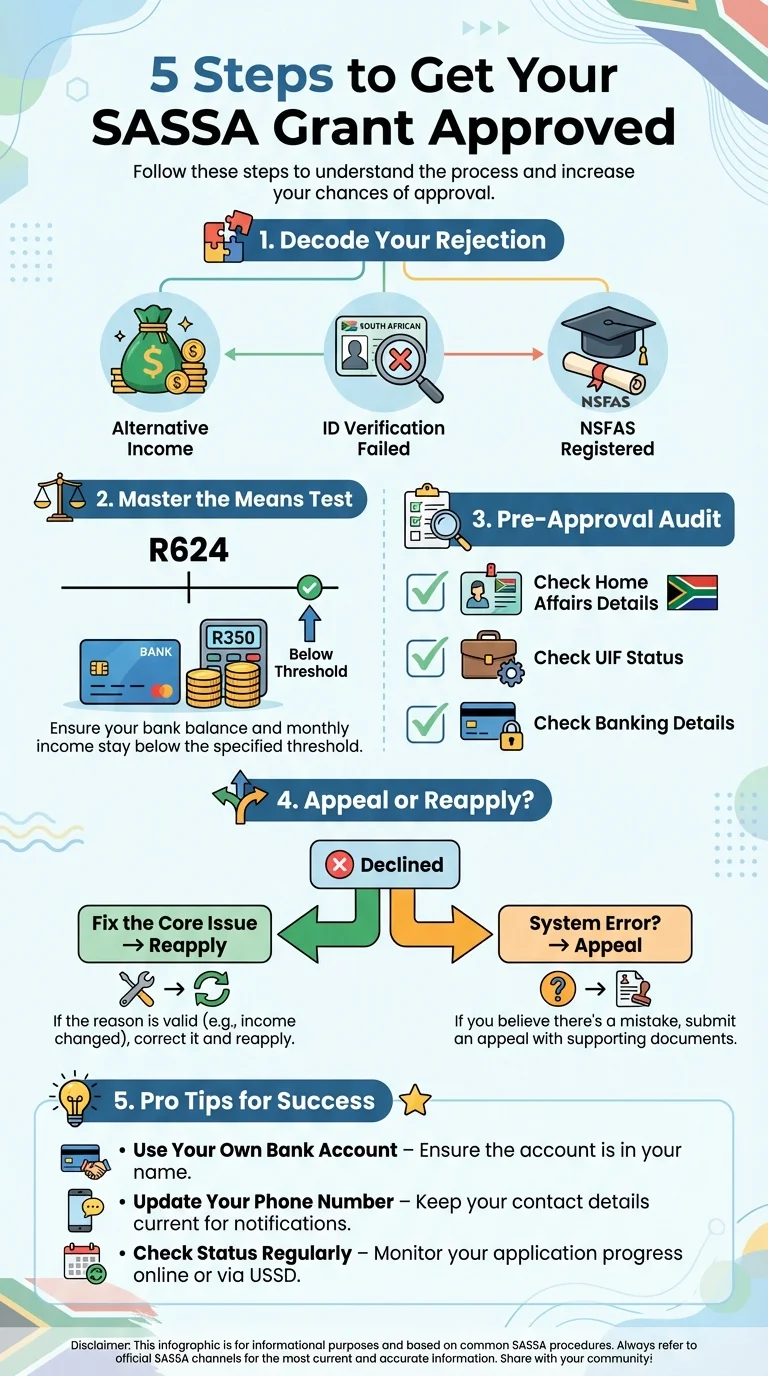
SASSA’s rejection reasons can feel like a foreign language. To win, you must become fluent. Let’s translate the most common reasons for failure in 2025:
- ‘Alternative Income Source Identified’: This is the most misunderstood reason. It does not mean you have a formal job. The system scans your bank account (linked to your ID number) for any inflow exceeding the R624 per month threshold. This could be a R700 gift from a relative, payment for a small one-off job, or even a refund. Winners know this and are meticulous about their bank activity. They ensure no single month’s income, from any source, crosses that line.
- ‘Identity Verification Failed’: This sounds like you made a typo, but it’s often deeper. SASSA cross-references your application with the Department of Home Affairs (DHA) database. If your name, surname, or ID number doesn’t match the DHA records exactly, you fail. This is common for people who have recently married or have errors on their ID documentation. Winners don’t guess; they verify their details with DHA before applying.
- ‘UIF Registered’ or ‘NSFAS Registered’: You might have been registered for UIF years ago at a job you’ve long since forgotten. The system doesn’t always know it’s inactive. Similarly, a past NSFAS registration can haunt your application. Winners are proactive; they check their status on the Department of Labour and NSFAS websites to ensure no old, phantom registrations are blocking their grant.
Strategy #2: Master the Means Test – It’s More Than Just Income
The means test is the invisible wall many applicants hit. As of December 2025, the rule is clear: if more than R624 enters your bank account in a given month, you are disqualified for that month. It’s a strict, automated check. There’s no human to hear your story that the R700 was for your child’s school uniform.
The Winner’s Approach:
- Know Your Cycle: SASSA checks your financial status for the preceding month. To be approved for January 2026, your bank account in December 2025 must have remained below the R624 threshold.
- Manage Your Inflows: If you do small jobs or receive help from family, try to manage it. Ask them to give you cash instead of an EFT if it risks pushing you over the limit. It’s not about hiding income, but understanding and playing by the system’s rigid rules.
- Use a Dedicated Account: If possible, use a bank account solely for personal use that you can monitor closely. Mixing it with business or favours from friends creates a messy financial picture that the automated system can easily misinterpret. A clear, low-balance account is the easiest path to approval.
Strategy #3: The Pre-Approval Audit – Fix Problems Before SASSA Finds Them
Why wait for SASSA to decline you? Successful applicants act like detectives, finding and fixing potential issues before they even submit their application or reapplication. Here’s your audit checklist for 2025:
- Department of Home Affairs Check: Is your name spelled correctly? Is your marital status up to date? Visit the DHA website or a local office to confirm the details linked to your ID are 100% accurate.
- Department of Labour Check: Go to the official Department of Labour website and check your ID number for any active UIF contributions. If you find an old employer has not terminated your status, you must contact them to fix it.
- Banking Details Double-Check: Log into your bank account. Does the name on the account match your ID document perfectly? Are you the owner of the account? Using someone else’s account is an instant rejection. For a detailed guide on checking your status, you can visit our SRD Status Check page.
Strategy #4: Choose Your Weapon – Appeal vs. Strategic Reapplication
When you get declined, you have two options: appeal or reapply for the next month. Choosing the right one is crucial.
When to Appeal: An appeal is for when you believe SASSA’s system made an error. For example, if they flagged you for ‘UIF Registered’ but you have proof you were never employed or that your status was terminated long ago. You are essentially saying, ‘Your data is wrong, and here is my proof.’ This process can be lengthy. For help with this, see our in-depth Appeals Guide.
When to Reapply Strategically: Reapplication is for when your circumstances were the problem, but they have now changed. For instance, if you were declined for ‘alternative income’ in November because a relative sent you R800, there’s no point appealing. You did exceed the threshold. The winning move is to ensure your income for December is below R624 and then simply reapply for the next cycle. This is often faster and more effective than a hopeless appeal.
Strategy #5: The Communication Game – Keeping Your Details Current
SASSA’s systems rely on the phone number you provide. It’s your primary link for communication, verification, and status updates. One of the most common, and easily avoidable, reasons for payment failure is an outdated phone number.
The Winner’s Golden Rules:
- One Number, One Application: Use a single, active cell phone number that is registered in your name. Don’t use a friend’s or relative’s number.
- Update Immediately: If you lose your phone or change your number, your absolute first priority should be to update your details on the SASSA SRD website. Failure to do so can lead to missed payments or even suspension of your grant.
- Guard Your Number: Be wary of scams asking for your PIN or personal details via SMS. SASSA will never ask for your bank PIN. Only use the official SASSA website or WhatsApp number to manage your grant.
Putting It All Together: Your Action Plan for 2026
Being approved for the SRD grant in 2025 and moving into 2026 is less about luck and more about strategy. Stop the cycle of applying and getting declined. Instead, take control.
- Investigate: Use our guide to decode your exact rejection reason.
- Audit: Check your details with Home Affairs, Labour, and your bank.
- Strategize: Manage your bank account to stay under the R624 means test.
- Execute: Choose wisely between an appeal and a strategic reapplication.
By adopting the mindset of a successful applicant, you dramatically increase your chances of moving from ‘Declined’ to seeing those welcome Payment Dates on your calendar. If you’re starting from scratch, make sure you follow every step in our Complete SRD Grant Application Guide.
Frequently Asked Questions
Why was my SASSA R350 grant declined if I have no job or income?
What does 'Identity Verification Failed' really mean?
Is it better to appeal or reapply if my grant is declined?
How long does it take to get approved after reapplying?
Can I get a SASSA grant if a family member sends me money?
My SASSA status has been 'Pending' for months. What can I do?
Why did SASSA decline me for being 'UIF Registered' when I haven't worked in years?
Will my grant be approved faster if I use a bank account instead of cash send?
Read Next
Home Affairs ID Crisis 2026: Your R390 SASSA Grant Now Blocked? Your Emergency Plan
BREAKING March 2026: A catastrophic system failure at the Department of Home …
Stage 8 Blackout: Your March 2026 SASSA R390 Payment is Trapped. The Ultimate Survival Guide.
BREAKING March 2026: Eskom has plunged South Africa into an unprecedented Stage …
Comments & Discussions