Table of Contents
Title: SASSA’s 2026 ‘Deceased’ Status Crisis: Your R390 Grant Blocked? Here’s How to Prove You’re Alive
It is terrifying to wake up and realize the government thinks you are dead. Following a massive report on “ghost beneficiary” fraud, SASSA has started a re-verification drive for 2026 that is accidentally freezing valid R390 SRD grants. If Home Affairs data glitches have labeled you “deceased,” you need to act fast to get your money back.
‘Operation Clean Slate’: The R333 Million Fraud That Just Froze Your R390 Grant
In February 2026, the Auditor-General dropped a report that makes my blood boil. It revealed that about R333 million is lost every year to fraudulent payments. The report found that roughly 75,000 monthly payments were going to people who are actually dead, creating a massive network of “ghost beneficiaries.” To fix this, the Department of Social Development launched “Operation Clean Slate.”
They want to biometrically check over 8.5 million recipients of the R390 Social Relief of Distress (SRD) grant by June 2026. I understand they need to protect public funds, but the rushed way they are doing this is a total disaster for honest people. The system is flagging living, breathing human beings as “Deceased” and cutting off their only source of income without a single warning. It feels like you are being punished for a computer’s mistake. This guide is your plan to fight back and prove you are still here.
Why Does SASSA Think You’re Deceased? The Home Affairs Data Glitch Explained
If your status says “Deceased,” it is because SASSA’s system hit a snag with the Department of Home Affairs (DHA) database. It is incredibly frustrating because this has nothing to do with anything you did. SASSA just trusts DHA data, even though we all know that database is full of typos and old records.
During this “Operation Clean Slate” mess, the algorithm is scanning millions of IDs. Even a tiny mistake at Home Affairs can trigger a “deceased” flag. Dr. Zola Khumalo, a social policy expert, pointed out that this re-verification is unfairly forcing the poorest people in South Africa to prove they exist just because of a glitchy algorithm. You shouldn’t have to prove you’re alive, but right now, the system assumes you are gone until you show up in person to argue otherwise.
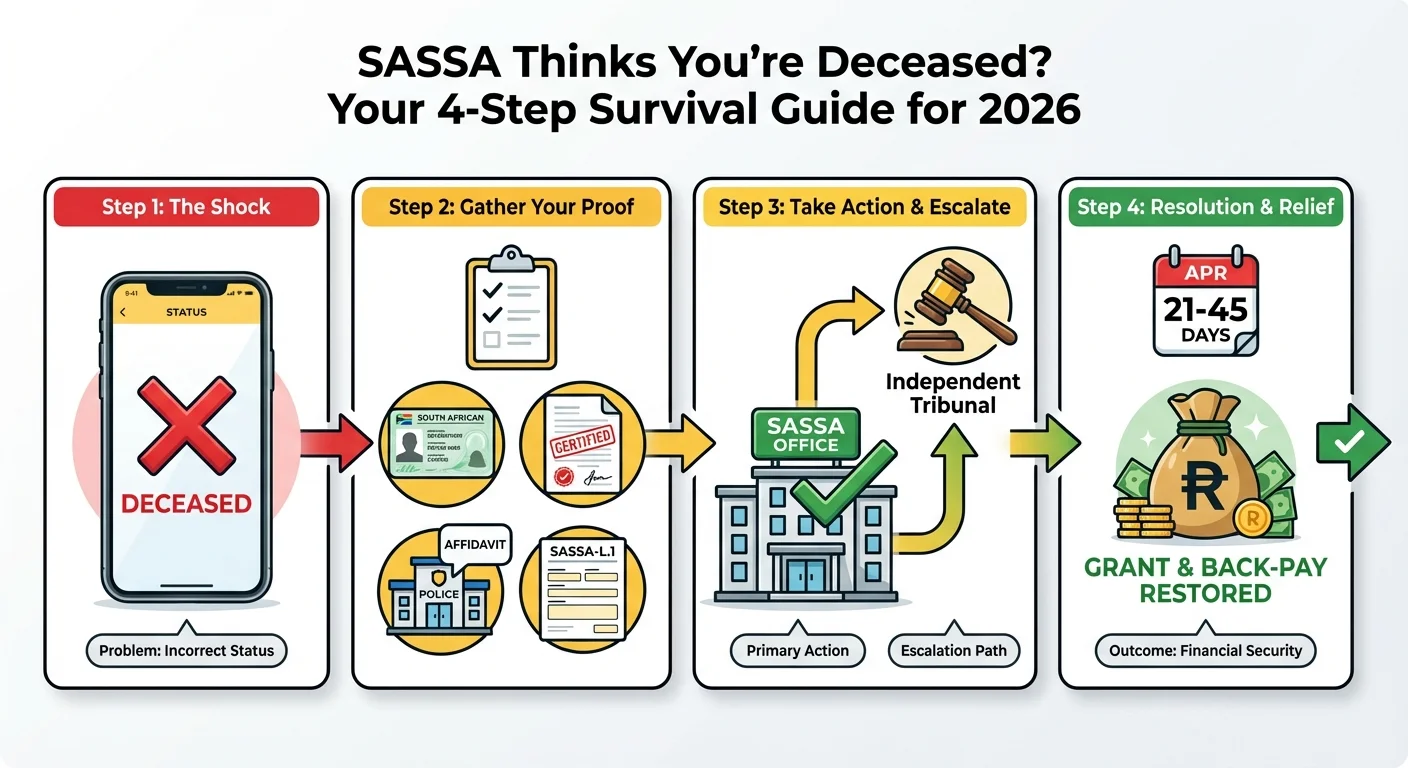
Step 1: Confirm Your ‘Deceased’ Status – The Official 2026 Check
Don’t spiral into a panic just yet. First, you need to see the error with your own eyes. Ignore the rumors on WhatsApp and check the official portal yourself. We have a SRD Status Check guide that links you directly to the right place.
When you check, if you are caught up in this mess, your status will say: ‘Status: Declined. Reason: Deceased.’ Seeing that on a screen is unsettling, but you need to take a screenshot of it immediately. That image is your proof that the system has officially made an error. Also, please do not pay anyone to check this for you. Those services are usually scams. The official check is always free.
Step 2: The ‘Proof of Life’ Process – Your 4-Document Emergency Kit
You cannot just sit back and hope SASSA fixes this. The system will not magically realize it made a mistake. You have to go there and show them you are alive. I have seen people get turned away for missing paperwork, so do not leave your house without these four things. SASSA’s 2026 rules for “Operation Clean Slate” are very strict.
- Your Original ID: Take your green book or Smart ID. They usually will not take temporary papers.
- A Certified ID Copy: Get this done at a police station or Post Office. It has to be fresh, meaning the stamp must be less than 3 months old.
- A Sworn Affidavit: While you are at the police station, tell them you need an affidavit. You are swearing under oath that you are who you say you are and that you are alive. The police stamp makes it a legal document.
- A ‘Proof of Life’ Form (SASSA-L.1): Some offices have these, but it is a good idea to ask for it the moment you walk in. You will sign it, and the official will sign it too.
Step 3: Lodging Your Case – SASSA Office vs. The Independent Tribunal
Once you have your papers, you have to face the SASSA office. I know the queues are a nightmare, but you have to do it. Ask for a supervisor and show them your kit. They will check your fingerprints and ID to clear that “Deceased” label from your profile.
Make sure you do not leave without a reference number or a signed receipt. SASSA says this should be fixed in 21 working days, but I would not hold my breath. If a month goes by and nothing changes, or if the office gives you the runaround, you need to file a formal dispute. You can do this through the Independent Tribunal for Social Assistance Appeals (ITSAA). We have an Appeals Guide that explains how to do this. It is a more serious legal step, but it is often the only way to get results when the local office fails you.
Restoring Your Payments: Timelines and Getting Your Back-Pay
After you have jumped through all these hoops, the big question is when the money starts flowing again. SASSA claims they will fix it in 21 working days, but with the sheer number of errors happening in 2026, I would expect it to take closer to 45 days.
The good news is that you will not lose the money from the months you were blocked. Since this was their mistake, you are legally owed back-pay. Once your grant is active again, you should get a lump sum for everything they missed. This is why that reference number is so important. It proves when you started the process and ensures they pay you every cent you are owed.
Frequently Asked Questions
What does the 'Deceased' status mean on my SASSA application for 2026?
Can I fix the SASSA 'Deceased' status error online or over the phone?
Will I be paid for the months my R390 grant was suspended due to the 'Deceased' error?
Is this 'Deceased' status problem related to the new SASSA Payment ID system?
How can I prevent this 'Deceased' status from happening to me?
What if Home Affairs has incorrectly declared me deceased? What's the first step?
Do I need a lawyer to resolve a SASSA 'Deceased' status issue?
If I am helping a frail or elderly relative, what documents do I need to prove they are alive?
Read Next
SASSA's New 'Mandatory App' Locks Your R390 Grant? The 2026 Guide for Beneficiaries Without a Smartphone
BREAKING April 2026: SASSA is rolling out a mandatory new smartphone app, …
The R140 Paraffin Price SHOCK: How 40% of Your R390 SASSA Grant Will Vanish on May 1st, 2026
BREAKING April 2026: NERSA has approved a devastating 40% increase in the price …
Comments & Discussions