Table of Contents
I’ve been tracking the latest moves from SASSA, and frankly, the new AI ‘Lifestyle Audit’ system is enough to make anyone nervous. If you’re relying on the R390 grant to get by, you need to know that an algorithm is now scanning your bank account for any reason to cut you off. This 2026 guide breaks down what this “spy” is actually looking for, how to handle money from your family without losing your grant, and the steps you must take to survive a review.
What is the SASSA AI ‘Lifestyle Audit’ and Why is it Happening in 2026?
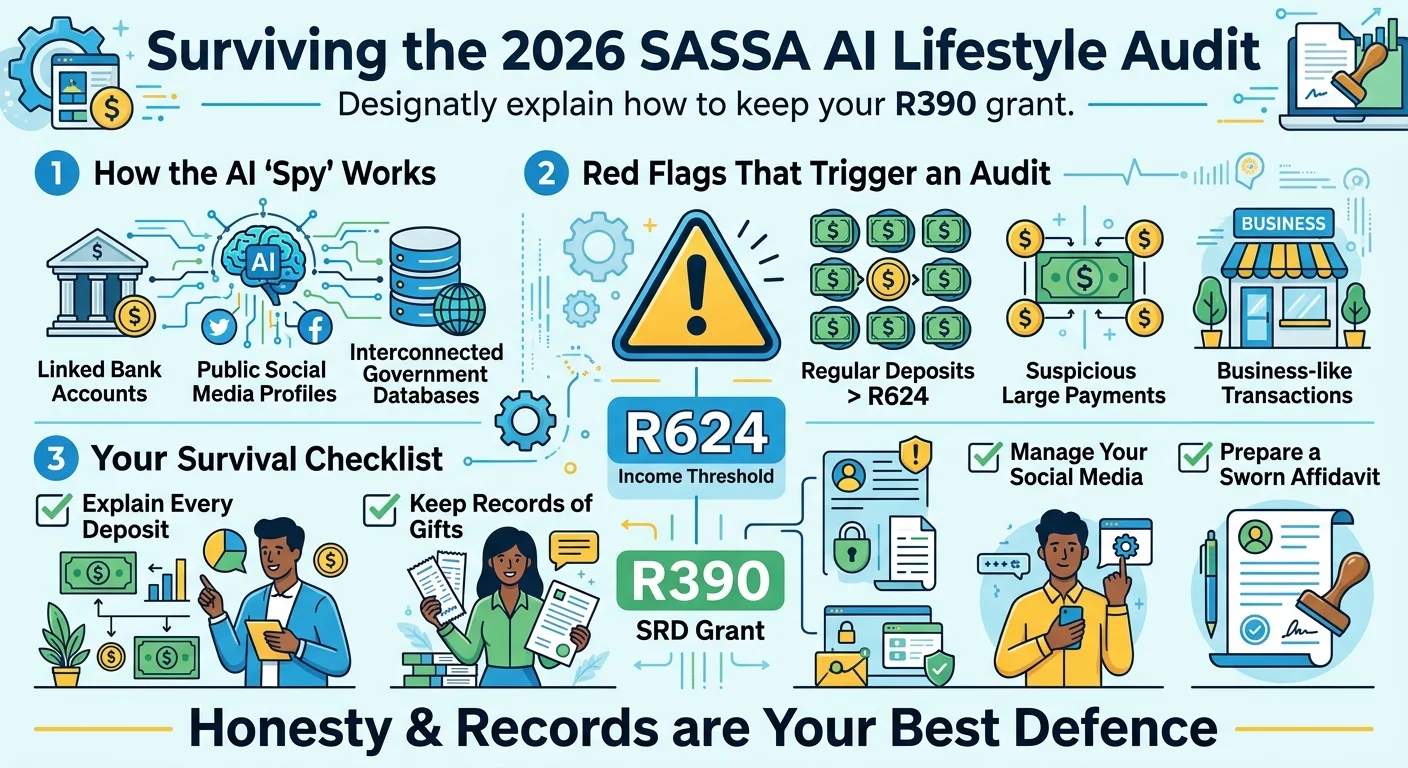
The SASSA AI ‘Lifestyle Audit’ is a cold, automated system designed to hunt for fraud by watching every move SRD grant beneficiaries make. It’s a harsh reality. Based on a Department of Social Development (DSD) directive that came to light in May 2026, this system uses artificial intelligence to dig through bank accounts linked to SASSA. It’s looking for any income that goes over the limit.
While the Auditor-General’s 2025 report says about R1.5 billion is lost to fraud every year, this technological crackdown feels like it’s casting too wide a net. The system compares your bank transactions with other government data to build a profile of all 8.5 million SRD recipients. The goal is simple: automatically stop payments to anyone who looks like they earn more than R624 a month. I’m worried that this “set it and forget it” approach is going to hurt honest people who are just getting a little help from their cousins or selling a few veggies to survive.
The R624 Red Flag: How the AI Decides You’re ‘Too Rich’ for a Grant
The AI doesn’t have a heart; it has a math problem. It works on a strict R624 monthly income limit. If the total money entering your bank account hits R625 in a 30-day window, the system flags you and your grant is probably going to be suspended. The problem is that the AI thinks any money coming in is “income.” It doesn’t know the difference between a paycheck and a gift.
Common Triggers for the AI System:
- Regular Deposits: If your brother sends you R200 every week to help with groceries, the AI sees a “regular income stream.”
- Stokvel Payouts: If your community savings club pays you R1000, you’ve instantly crossed the line and will be flagged.
- Small Side Hustles: If you sell airtime or snacks and people pay you via bank transfer, the AI marks that as business revenue.
- Getting Paid Back: If a friend owes you R700 and pays it into your account, the system assumes you’ve found a job.
Dr. Thandi Mkhize, a social policy analyst, puts it perfectly: “The system’s flaw is its inability to understand context. It sees a number, not the human story behind it.” A gift to buy a child school shoes shouldn’t be treated like a salary, but right now, it is.
Your Digital Footprint: Why Your Social Media Could Cost You Your Grant
It’s not just about your bank account anymore. Your life online is also being watched. The DSD directive allows investigators to look at public social media profiles during a review. In 2026, what you post is part of your “lifestyle profile.”
If you’re flagged, an investigator might look at your Facebook or Instagram. If they see photos of you at a fancy party, wearing expensive-looking clothes, or showing off a new phone, they’ll use it as evidence that you don’t actually need the R390. I know it feels like an invasion of privacy, but they are looking for anything that doesn’t match the “no income” status. My advice? Set your profiles to private and be very careful about what you share publicly. You don’t want a photo from a friend’s wedding to be the reason you can’t buy bread next month.
The ‘Gifts vs. Income’ Trap: How to Explain Money from Family and Friends
This is the biggest trap of the AI audit. In South Africa, we survive because we help each other. But if your mom sends you R700 for a birthday, the AI just sees a red flag. To keep your grant, you have to prove that money wasn’t a salary.
Your Action Plan:
- Use Clear References: When someone sends you money, tell them to use a reference like “Gift” or “Family Support.” Don’t let them leave it blank or use “Payment.”
- Get a Sworn Affidavit: If you get flagged, go to the police station and sign a sworn statement. Explain exactly where the money came from and that it isn’t a regular income.
- Get a Backup Statement: If you can, have the person who sent the money sign their own affidavit saying it was a gift. It sounds like a lot of work, but it’s the only way to beat the algorithm.
The burden is on you to prove you’re still poor enough to qualify. SASSA won’t take your word for it; they want the paperwork.
Surviving the Review: Your Step-by-Step Guide to Proving Your Eligibility
If your status suddenly changes to “Pending” or “Declined,” don’t panic, but do act fast. You have the right to fight back. First, check your status on the official SRD Status Check page to see exactly what’s happening.
Here is your survival guide:
- Get Your Bank Statements: Print out three months of statements for the account SASSA uses.
- Mark Every Deposit: Take a pen and go through every cent that came in. Next to every deposit over R100, write what it was for (e.g., “Money from sister for electricity”).
- Write Your Affidavit: Be honest and detailed. State clearly that you are unemployed and explain any big transfers the AI might have hated.
- Gather Proof: If you have a letter from a Stokvel or a note from a family member, keep it ready.
- Submit for Reconsideration: Follow the SASSA steps to ask them to look at your case again. Attach your annotated statements and affidavits. If that doesn’t work, you have to lodge a formal appeal. Use a reliable Appeals Guide so you don’t miss any deadlines.
Frequently Asked Questions
What does the R10,000 'Lifestyle Audit' amount refer to?
Can SASSA legally check my bank account without my permission?
What happens if I receive more than R624 in one month as a gift?
How do I prove my 'side hustle' income is below the SASSA limit?
Will my grant be cancelled forever if I fail the audit?
Does this AI audit affect other grants like the Child Support or Older Persons Grant?
Read Next
SASSA June Payment Update: June 2026 Payment Cycle Confirmed
The June 2026 SASSA payment cycle is confirmed for 2, 3 and 4 June 2026 for the …
The R50 Billion Food Waste SHOCK: Why Your R390 SASSA Grant Can't Buy Food While SA Throws It Away
BREAKING May 2026: A shocking new report reveals South Africa wastes over R50 …
Comments & Discussions