
Table of Contents
Title: The R1,500 YES Stipend vs. Your R390 SASSA Grant: The 2026 ‘Income Trap’ and How to Navigate It
If you are a young South African SASSA beneficiary, the 2026 Youth Employment Service (YES) programme might look like a lifeline, but it could actually be a financial trap. I’ve seen many young people jump at the R1,500 stipend only to realize they are actually worse off than when they were surviving on the R390 grant. This guide breaks down the math, the risks, and the bureaucratic mess you need to avoid.
The Hidden ‘Income Trap’: Why a Youth Stipend Could Cost You Your SASSA Grant
The government’s Youth Employment Service (YES) programme is often talked about as the solution to our youth unemployment crisis. With Stats SA showing unemployment for under-25s sitting above 60% in 2026, a R1,500 stipend for work experience sounds like a no-brainer. But here is what worries me: for millions of you relying on the R390 Social Relief of Distress (SRD) grant, this opportunity has a nasty sting in the tail.
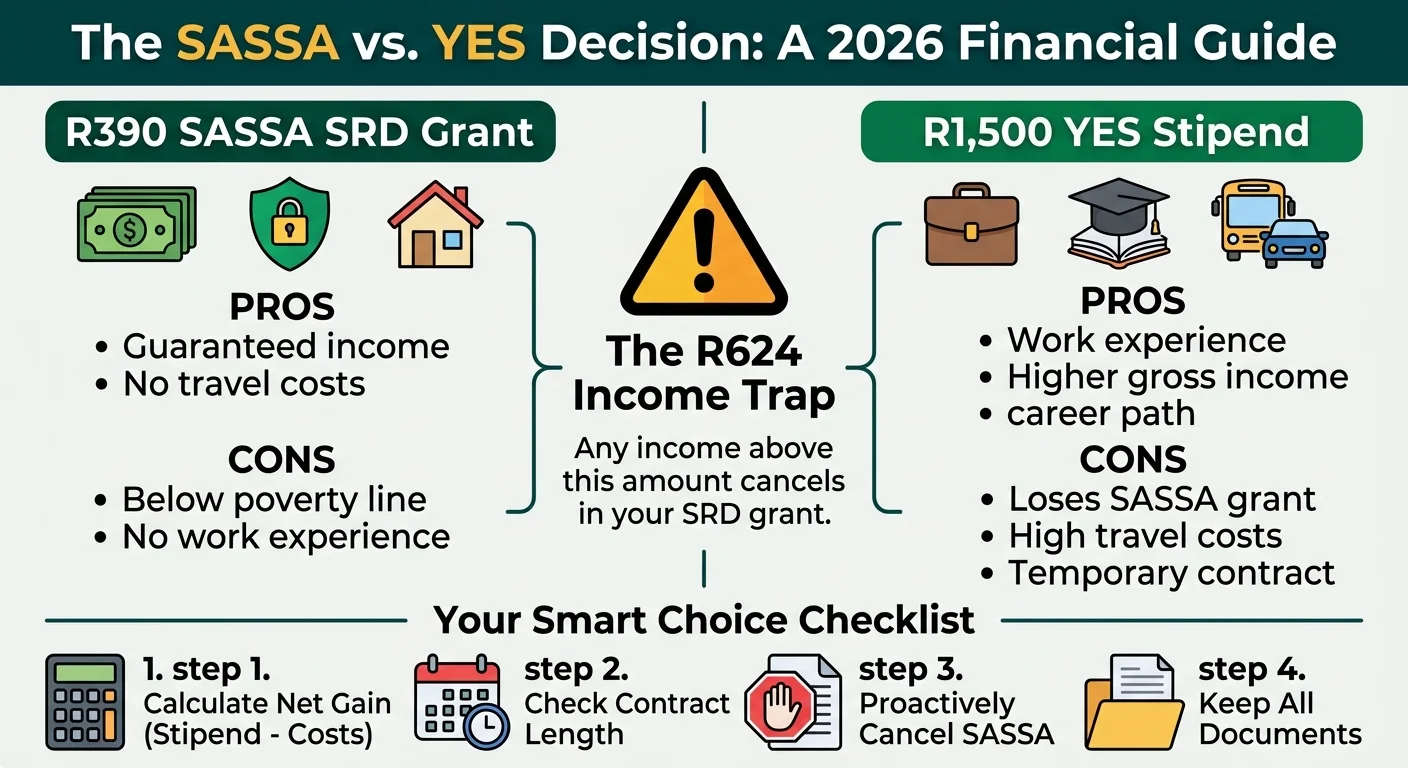
The problem is SASSA’s rigid means test. By May 2026, if you have more than R624 hitting your bank account in a month, you are out. Since the R1,500 YES stipend is more than double that limit, the system will flag you almost immediately. Because of the way different government departments now share data, SASSA will know about your new income before you even finish your first week of work. This is the “income trap.” You take a job to get ahead, but once you pay for transport, food, and data, you might actually have less money in your pocket than when you stayed home with your R390 grant.
How SASSA Automatically Detects Your YES Stipend
Don’t think you can just keep quiet about the stipend and keep the grant. It doesn’t work like that anymore. Your SRD grant will stop the second the system sees that money. SASSA has moved away from just taking your word for it. In 2026, they are using an aggressive data-matching system that talks to SARS, the UIF, and the Treasury.
When you sign up for YES, your ID number goes into a national database. Every month, SASSA’s computers run a check. When they see R1,500 linked to your ID, your status will flip to “Income Source Identified.” There’s no phone call and no warning. You’ll just see a “Failed” status on your next check. It’s a cold, automated process designed to stop what they call “double-dipping.” If you’re worried about your status, you should do a regular SRD Status Check to see exactly where you stand.
Your 4-Step Solution: What to Do BEFORE Accepting a YES Offer
I hate seeing people get stuck in financial limbo because they didn’t have a plan. Before you sign that YES contract, follow these steps to make sure you aren’t shooting yourself in the foot.
Step 1: Do the real math. Forget the R1,500 figure for a second. Ask exactly what you’ll be taking home after any deductions. Then, sit down and work out your costs. How much is the taxi to work every day? What about lunch or the extra data you’ll need? If your transport alone is R800 a month, you’re only “earning” R700. Subtract the R390 grant you’re losing, and you’re working a full-time job for an extra R310 a month. Is that worth it to you?
Step 2: Check the clock. Is this a 3-month gig or a full year? Short contracts are dangerous. If you lose your grant for a job that only lasts 90 days, you might spend the next three months fighting SASSA just to get your R390 back.
Step 3: Be the one to tell SASSA. If you decide the experience is worth it, don’t wait for the system to catch you. Go to the SRD website and cancel your grant yourself. Use the “New Source of Income” reason. It looks much better on your record and prevents you from being flagged as a “defaulter,” which can make reapplying a nightmare later.
Step 4: Save every piece of paper. Keep your contract, every payslip, and a letter that clearly states when your job ended. You are going to need these. Without them, your future reapplication will likely get stuck in “Pending” forever.
The Reapplication Nightmare: Why Getting Back on SASSA Isn’t Automatic
A lot of people think that once the YES contract ends, the R390 grant just starts up again. I wish that were true, but it’s not. Once you’re off the list, you’re off. You have to start a brand-new application from scratch.
This is where it gets ugly. It can take 30 to 90 days to get approved again. Even worse, if the YES database hasn’t updated to show you’ve finished, SASSA’s system will keep rejecting you because it still “sees” an income. Groups like Black Sash have found that about 25% of people trying to get back on the grant get rejected for this exact reason. If you find yourself in this mess, you’ll have to start the slow appeals process. You can find out how to do that in this Appeals Guide.
Is It Worth It? A Financial Breakdown for Young South Africans
Whether this move makes sense depends entirely on your specific situation. Let’s look at two people in May 2026.
Scenario A: Thabo in Soweto
- YES Offer: R1,500/month, but the job is in Sandton.
- Transport: R40 a day for taxis = R880/month.
- Lunch/Data: R440/month.
- Total Costs: R1,320.
- Net Income: R180.
- The Verdict: Thabo is basically working for free. He gives up his R390 grant for a net gain of R180. Unless that work experience is gold, he’s actually hurting his bank account by taking the job.
Scenario B: Nomfundo in Khayelitsha
- YES Offer: R1,500/month at a clinic she can walk to.
- Transport: R0.
- Lunch/Data: R440/month.
- Net Income: R1,060.
- The Verdict: This is a win. Nomfundo more than doubles her money compared to the grant and gets a CV boost. For her, it’s a great move.
A Call for Policy Reform: Bridging the Gap Between Grants and Work
The current setup is broken. It basically punishes young people for trying to work. Experts like Dr. Elriza Pelser have pointed out that this “all-or-nothing” approach is a mistake. We need a system where the grant doesn’t just vanish the moment you earn a cent. A tapered system, where the grant slowly decreases as you earn more, would stop people from falling off this financial cliff.
Until someone in government fixes this, you have to be your own strategist. The YES programme can be a great first step, but don’t let it leave you broke. Weigh the long-term career benefits against the short-term struggle. It’s a tough choice, and it’s the reality for millions of young South Africans in 2026.
Frequently Asked Questions
Will I automatically lose my R390 SRD grant if I join the YES program in 2026?
What is the exact SASSA income threshold for the SRD grant in May 2026?
How do I cancel my SRD grant if I accept a YES position?
Can I reapply for the R390 grant after my YES contract ends?
What happens if I don't tell SASSA about my YES stipend?
Are transport and other work-related costs considered by the SASSA means test?
Read Next
SASSA June Payment Update: June 2026 Payment Cycle Confirmed
The June 2026 SASSA payment cycle is confirmed for 2, 3 and 4 June 2026 for the …
The R50 Billion Food Waste SHOCK: Why Your R390 SASSA Grant Can't Buy Food While SA Throws It Away
BREAKING May 2026: A shocking new report reveals South Africa wastes over R50 …
Comments & Discussions