Table of Contents
Title: The R150 Water Bill Shock: 2026 Tariff Hikes to Wipe Out 40% of Your SASSA Grant
It is hard to wrap my head around the sheer cruelty of the latest municipal math. Just as millions of people are trying to figure out how to stretch a R390 SASSA grant to cover a month of groceries, the floor is being pulled out from under them again. Major cities have confirmed massive water price hikes for 2026, and if you are a beneficiary, this isn’t just a budget adjustment—it is a survival crisis.
The Dam Wall Breaks: Massive 2026 Water Tariff Hikes Announced
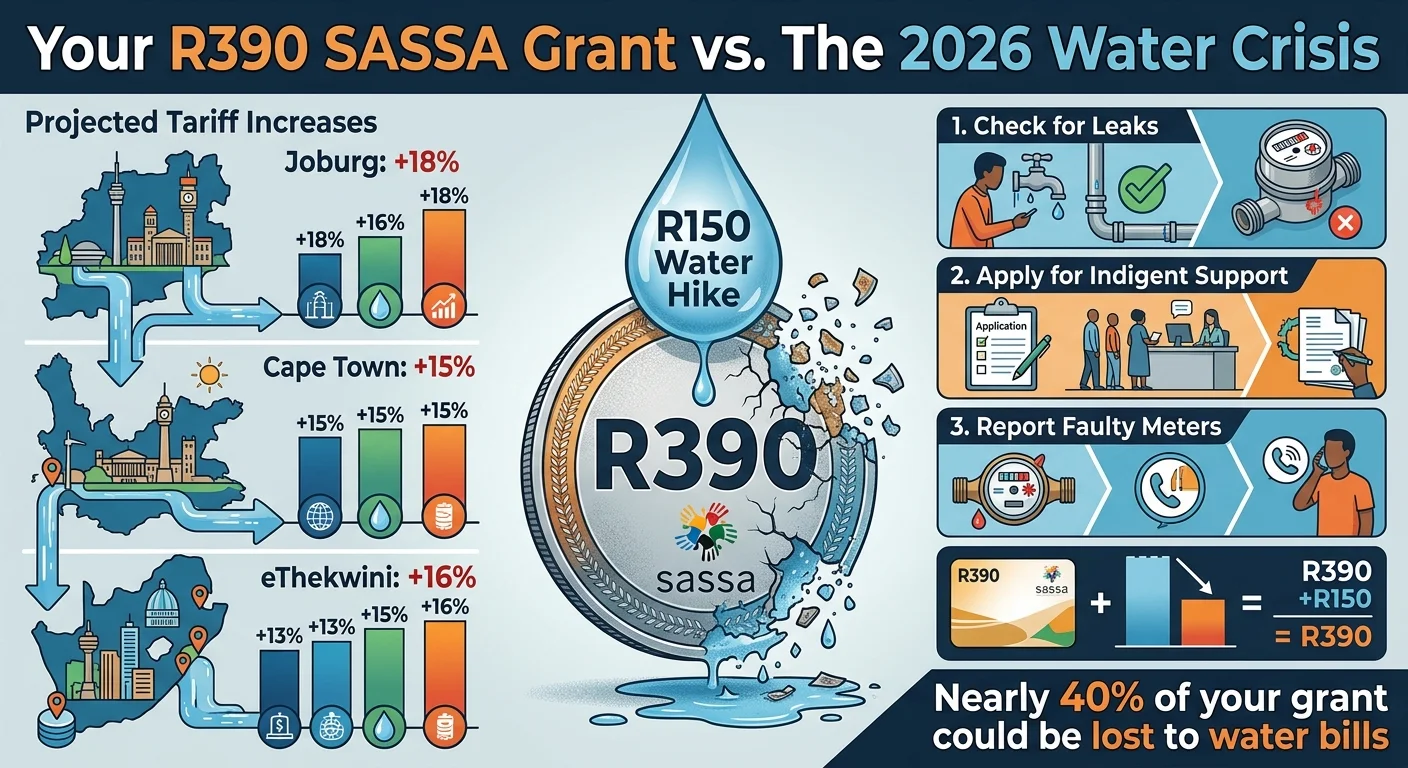
In late March 2026, a crisis that has been simmering in council chambers for years finally boiled over. Major cities like Johannesburg, eThekwini, and Cape Town have confirmed double-digit increases for water and sanitation that will kick in on 1 July 2026. According to reports from News24 and Daily Maverick, these aren’t small tweaks. Johannesburg is looking at an 18.6% jump, eThekwini is hitting 16%, and Cape Town residents should prepare for about 15% more on their bills.
For anyone relying on the R390 SRD grant, this is terrifying. It comes at a time when the grant’s buying power is already being eaten away by the price of maize meal and taxi fares. Municipalities say they have no choice because of old pipes, the high cost of buying water from Rand Water, and the massive debt they owe to Eskom. Stats SA data from 2025 shows municipal debt has climbed past R100 billion. But let’s be honest: this feels like the government is asking the poorest people in South Africa to pay for years of municipal neglect and broken infrastructure.
From R390 to R240: Calculating the Real Impact on Your SASSA Grant
Percentages can feel abstract until you see the actual Rands disappear from your pocket. Let’s look at what this really does to a household. If you used to pay R300 for water, that bill is headed toward R350 or R360. For many, this hike will mean finding an extra R100 to R150 every month just to keep the taps running.
When your entire monthly income is a R390 grant, losing R150 is a disaster. It effectively slashes your grant to just R240. That is nearly 40% of your total support gone to a single utility bill. It forces you into impossible choices: Do you buy paraffin, or do you pay for water? Do you skip a meal to keep the lights on? A 2025 study by the Pietermaritzburg Economic Justice & Dignity Group found that a basic food basket already costs over R5,200. The R390 grant was already too small; these hikes make it feel like a drop in the ocean. You need to stay on top of your money, so make sure to check the latest Payment Dates to plan ahead.
Why Now? The Perfect Storm of Municipal Collapse and Eskom Debt
This isn’t happening by accident. It’s the result of years of failure at the local level. Auditor-General reports have been warning us for a long time about money being wasted and pipes being left to rot. In some areas, over 40% of water is simply lost to leaks before it even reaches a home. Now, the people who actually pay their bills are being forced to cover the cost of that wasted water.
And then there is the debt. Municipalities owe billions to Eskom and various Water Boards. To keep themselves from going bankrupt, they are squeezing the residents. It’s a trap: as prices go up, fewer people can pay, the debt grows, and the city raises prices again the next year. It’s a downward spiral, and SASSA beneficiaries are the ones being dragged down the fastest.
Government’s Contradiction: Giving with One Hand, Taking with the Other
I find the logic here deeply frustrating. On one hand, the National Treasury spends over R250 billion a year on SASSA grants because they know people are starving. The R390 SRD grant is meant to be a lifeline. But then, on the other hand, local municipalities are allowed to hike prices so high that they effectively take that money back.
What is the point of a small R20 grant increase if a R150 water bill hike follows it a month later? It shows a massive gap between national policy and local reality. It feels like a shell game where the money just moves from the Treasury, through your bank account, and straight into a failing municipality’s pocket to fix holes they should have fixed a decade ago. It’s not helping people get ahead; it’s just keeping them in a cycle of debt. To see where your application stands, you can use the SRD R350 Status Check portal.
Your Survival Guide: How to Fight Back and Reduce Your Water Bill in 2026
You might feel helpless, but there are a few things you can do to protect yourself. You have to be proactive to save every cent of your grant.
Register as an Indigent Household: This is the most important step. If your household income is low (usually under R4,400 in 2026, or the value of two state pensions), you qualify for free basic services. This usually includes 6,000 litres of free water a month. It won’t solve everything, but it is a huge help. Go to your municipal office with your ID and a SASSA statement as proof of income.
Hunt for Leaks: Even a tiny drip can waste enough water to cost you R100 a month. Check your meter, wait an hour without using any water, and check it again. If the numbers moved, you have a leak. Fix it or report it immediately.
Fight Wrong Bills: Don’t just pay a bill that looks wrong. Municipal billing is often a mess. Take a photo of your meter every month. If the bill is way off, lodge a formal dispute at the municipal office. They aren’t allowed to cut your water while a legal dispute is being looked at.
Save Every Drop: It sounds simple, but using a basin instead of a running tap or reusing greywater for the toilet can shave Rands off your bill. Every litre saved is money kept in your pocket for food.
Talk to Your Neighbors: If a whole street is struggling, go to your ward councillor together. There is more power in a group than in one person complaining alone. Sometimes organizations like the Legal Resources Centre can help communities fight unfair price hikes.
Frequently Asked Questions
How much is the average water tariff increase for 2026?
Does this water tariff hike affect my free basic water allowance?
Can the municipality cut off my water if I can't pay the new amount?
How do I apply for the government's free water for the poor (indigent support)?
Why are water prices going up so much in 2026?
My SASSA grant was declined. Will I still be charged for water?
Read Next
The R500 'SASSA Easter Bonus' SMS is a Scam: Your 2026 Guide to Protecting Your R390 Grant
BREAKING for March 2026: A new, highly convincing SMS scam is promising a R500 …
SASSA April Payout Alert: Major Retailers Warn of 'System Upgrade' Delays Ahead of Easter 2026
BREAKING March 2026: Major SASSA retail pay points like Shoprite, Pick n Pay, …
Comments & Discussions