Table of Contents
South African municipalities are currently drowning in over R100 billion of debt, and I find it deeply concerning how they are trying to fix their balance sheets. Reports from May 2026 show that councils are turning to “aggressive revenue collection” to stay afloat. If you rely on a SASSA grant, you are likely worried about whether they can snatch your R390 to pay for water and electricity. I have looked into the law, and while the short answer is no, the reality on the ground is a lot messier than it should be.
The R100 Billion Crisis: Why Your SASSA Grant is Suddenly in the Crosshairs
It is hard to wrap your head around the scale of this financial disaster. A recent Auditor-General report from early May 2026 shows that municipal debt to Eskom and various water boards has blown past R100 billion. News24 says councils are now desperate, using “aggressive revenue collection” just to keep their doors open. For the 9 million people living on the R390 Social Relief of Distress (SRD) grant, this isn’t just a headline. It feels like a target on their backs.
I am worried because we have seen this pattern before. GroundUp has highlighted how municipalities have historically tried to squeeze the most vulnerable by attaching assets. With the 2026 crisis hitting a breaking point, that R390 grant is looking like an easy fix for councils that cannot manage their own books. They are desperate for every cent, and that puts your lifeline directly in their line of sight.
The Law vs. Reality: Is Your R390 Grant Legally Protected?
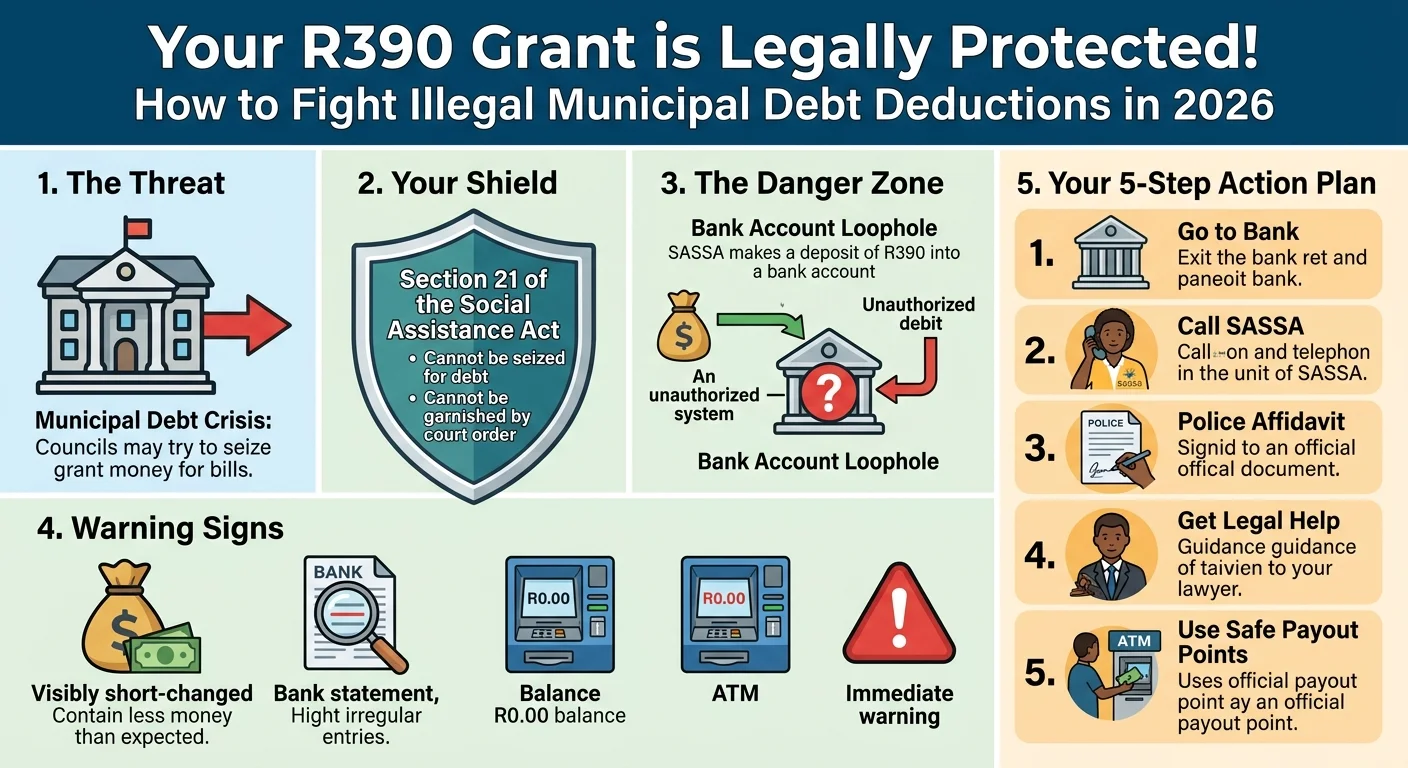
The good news is that the law is actually on your side. The primary protection is Section 21 of the Social Assistance Act of 2004. This clause is very clear: a social grant “may not be transferred, ceded, pledged or in any other way encumbered” and cannot be taken through a court order. Simply put, no municipality has the legal right to touch your grant to pay off a debt.
I have followed groups like the Black Sash for years, and they are firm on this: these grants are for survival, not for fixing municipal budget holes. Even the Institute for Economic Justice (IEJ) pointed out in 2025 that this protection should be absolute. But there is a catch that worries me. Once that money hits a regular bank account, it enters a grey area where desperate municipalities might try to bypass the rules.
The ‘Bank Account Loophole’: How Municipalities Might Bypass the Law
This is what keeps me up at night. The grant itself is protected, but once SASSA puts that R390 into a bank like Capitec, FNB, or Standard Bank, it just looks like numbers in an account. Banks use automated systems that do not always care where the money came from. If a municipality sends a massive list of ID numbers to a bank to collect arrears, the system might just process the deduction.
This is not a legal “garnishee order.” It is just a cold, automated administrative error. In 2025, the banking ombudsman saw a 15% jump in complaints about these kinds of unauthorized debits. It is a huge risk if you use the same account for your grant and your municipal bills. You can check the latest SASSA Payment Dates to stay ahead of the curve, but the timing is often what trips people up. If your payment date matches the billing cycle, you are at risk.
Red Alert: 4 Warning Signs Your Account Has Been Targeted
You have to be your own watchdog. An illegal deduction is often quiet, so you need to watch your account like a hawk around payment day. Look for these four signs:
- The ‘Short’ Payment: You get an SMS, but the math is wrong. If you are expecting R390 and see R150, something has been taken.
- Strange Transaction Codes: Look at your statement. If you see “Mun-Debit,” “Council Levy,” or “SVC-Payment” and you did not pay it yourself, that is a red flag.
- The Disappearing Balance: You go to the ATM and it shows R0.00 even though you know you were paid. This usually means the whole amount was seized.
- Failed Debit Fees: If your account was empty but you see a R20 or R50 “Unpaid Item Fee,” it means someone tried to pull money and failed.
Your 5-Step Action Plan: How to Fight Back Against Illegal Municipal Deductions in 2026
If you find that your money has been taken, do not panic. You have to act fast to get it back.
- Get to the bank immediately. Take your ID and SASSA card. Demand a statement and lodge a formal dispute. You have rights as a consumer to stop unauthorized debits. Tell them the money is a protected grant and they must reverse it.
- Report it to SASSA. Call the national hotline at
0800 60 10 11. Tell them exactly what happened. They need this info to see which municipalities are breaking the law. Always ask for a reference number. - Get a police affidavit. This sounds like a hassle, but it is vital. Go to the station and swear under oath that your protected grant was taken without permission. This paper is powerful evidence for your bank.
- Talk to the experts. Reach out to the Black Sash or the Legal Resources Centre (LRC). They do incredible work for free and can help push the bank or the council to give your money back.
- Change how you get paid. If your bank account feels like a target, switch to cash. Collect your grant at Pick n Pay, Shoprite, or Boxer. If the money is not in a bank account, no automated system can touch it. Use the SRD Status Check to make sure your payment is ready before you head out.
Frequently Asked Questions
Is it legal for any municipality in South Africa to take my SASSA grant money for electricity or water debt?
What does Section 21 of the Social Assistance Act actually say?
Are my funds safer if I use a SASSA Gold Card or Postbank account?
How can I prove to my bank that the money taken was my SASSA grant?
Who can I report these illegal deductions to for free legal help?
0800 60 10 11). For free legal assistance and advocacy, you should contact non-profit organisations like Black Sash or the Legal Resources Centre (LRC), which specialise in protecting the rights of social grant beneficiaries in South Africa.Does this legal protection apply to all SASSA grants or just the SRD R390 grant?
Read Next
SASSA June Payment Update: June 2026 Payment Cycle Confirmed
The June 2026 SASSA payment cycle is confirmed for 2, 3 and 4 June 2026 for the …
The R50 Billion Food Waste SHOCK: Why Your R390 SASSA Grant Can't Buy Food While SA Throws It Away
BREAKING May 2026: A shocking new report reveals South Africa wastes over R50 …
Comments & Discussions