
Table of Contents
Title: The R50 Taxi Bombshell: How 2026 Fare Hikes Will Erase R100 From Your R390 SASSA Grant
I’ve been looking at the numbers for the 2026 SASSA grants, and honestly, they just don’t add up anymore. This deep-dive looks at the March 2026 taxi fare hikes across South Africa and the math that is about to break the bank for R390 grant recipients. We look at why this is happening and how you can try to survive a massive drop in what your money can actually buy.
The R50 Bombshell: Nationwide Taxi Fares Skyrocket in March 2026
It is the news millions of South Africans were dreading. On 2 March 2026, the National Taxi Alliance (SANTACO) made it official. After talking with the Department of Transport, they are rolling out a nationwide, multi-tiered fare hike starting 1 April 2026. This isn’t just a small change, it’s a total financial blow. Major routes in Gauteng, KZN, and the Western Cape are looking at single trips jumping from R18 to as high as R25. This means a simple trip to town and back will now cost a staggering R50.
SANTACO says they have no choice. They point to the “Green Tax” on petrol that added R2 in the February 2026 budget, plus the fact that vehicle parts and maintenance have gone up 12% in a year. The Alliance knows that 70% of the 15 million people who use taxis every day are from low-income homes, and many are social grant recipients. This hike is basically a direct tax on the most vulnerable people in the country. These are people who have no other way to get to clinics, schools, or the shops where they collect their money.
Your R390 Grant is Now an R290 Grant: The Brutal Maths
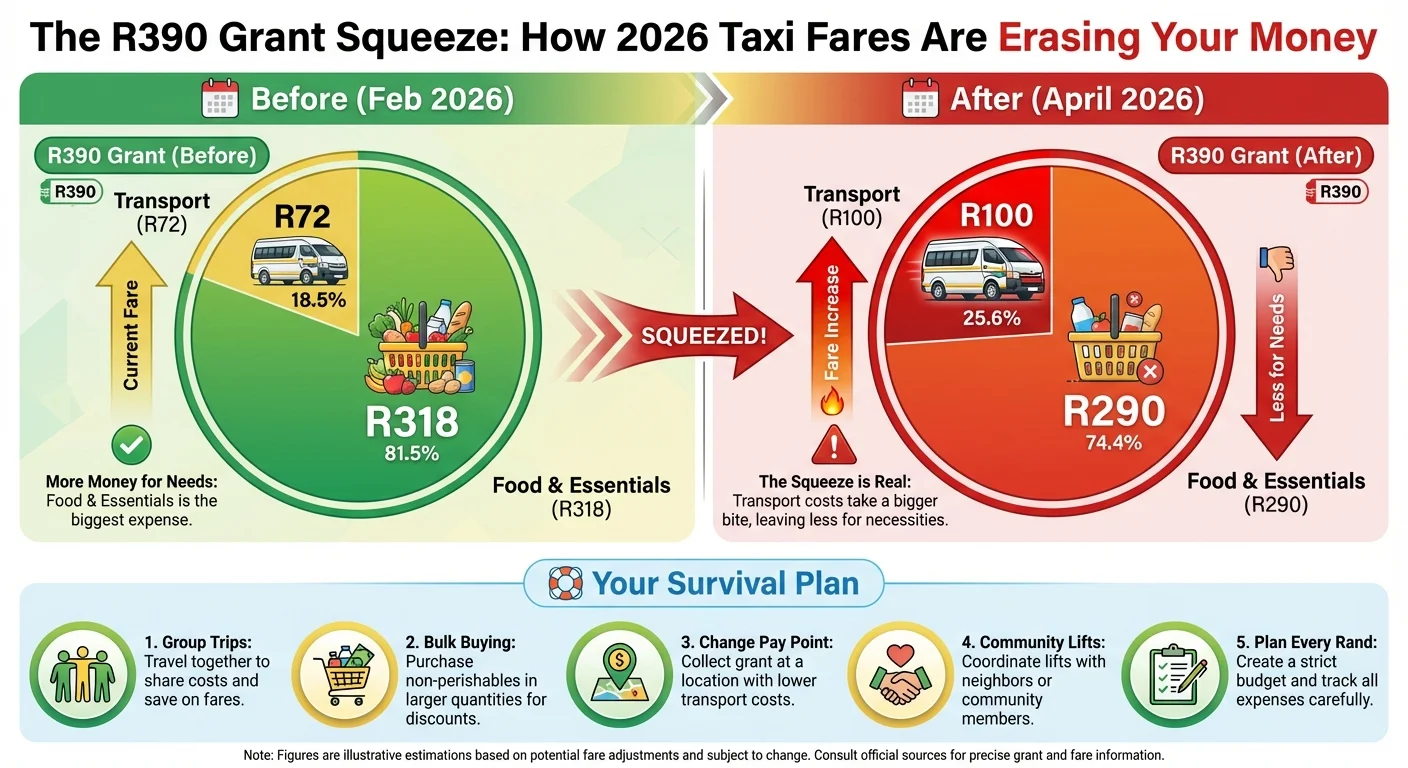
The government made a big deal about the R20 increase to the SRD grant in the 2026 Budget Speech, bringing it to R390. But these taxi hikes make that “increase” look like a joke. Let’s look at the real math for a typical SASSA beneficiary. If you live in a township, you need at least two return trips a month: one to get your cash and one for a basic grocery run.
February 2026 Budget:
- Average return trip cost: R36 (R18 x 2)
- Two essential return trips: R72
- Remaining from R390 grant: R318
April 2026 Budget (Post-Hike):
- Average return trip cost: R50 (R25 x 2)
- Two essential return trips: R100
- Remaining from R390 grant: R290
This isn’t some abstract theory. It is a direct loss of R82 in what you can actually buy. That is four times the R20 “raise” people just got. For millions, the R390 grant has basically become an R290 grant overnight. And this doesn’t even count trips for the clinic, looking for work, or seeing family. This forces people into an impossible spot: do you skip buying food or do you stay stranded at home? It feels like a poverty trap designed by policy, and it’s closing in fast.
‘Our Taxis Will Stop Running’: The Industry’s Desperate Stand
It’s easy to blame the taxi industry, but they are caught in a bad spot too. A spokesperson for a regional association recently said in a TimesLive report that they aren’t hiking prices to get rich, they are doing it to survive. They mentioned how the government adds a R2 fuel levy and the Rand gets weaker, making tires more expensive.
The industry is frustrated because they get zero government subsidies, unlike buses or trains, even though they are the backbone of transport in South Africa. They claim that if they don’t raise prices, their taxis will be repossessed and communities will be left with no transport at all. This shows a massive problem: the government keeps adding costs to essential services but provides no safety net for the drivers or the people who rely on them.
A Policy Failure: Government’s Silence Condemns the Poor
The government’s role in this mess is hard to ignore. It feels like the right hand has no idea what the left hand is doing. The National Treasury adds a fuel tax, Social Development gives a tiny R20 grant increase, and the Department of Transport just watches the fare hikes happen. This lack of coordination is a disaster for the poor.
I have to wonder, where are the transport subsidies for SASSA beneficiaries? Why isn’t there a special lower rate for grant collection days? These aren’t wild ideas, they are necessary in a country with so much inequality. By doing nothing, the government is letting poverty relief money get sucked up by transport costs they helped create. If you find that your grant isn’t enough or you’re struggling with a rejection, you should check your options in our SASSA Appeals Guide. We need smarter policies, not just small cash handouts that disappear instantly.
Your 2026 Survival Plan: 5 Ways to Fight Back Against Killer Transport Costs
Feeling stuck is the worst, but we have to find ways to make it work. While we should keep demanding better from the government, here are five ways to try and save some of that transport money:
- Start a ‘Grant Day’ Travel Group: Talk to a few neighbors you trust. If four of you share a taxi to the shopping center, you can split that R50 return fare. Paying R12.50 instead of R50 makes a huge difference.
- Buy in Bulk Whenever Possible: Use any money you save on transport to buy the basics in bulk. Maize meal, oil, and sugar last a long time. If you buy more at once, you won’t have to take as many trips to the store, which saves you a R50 fare every time.
- Check for Closer Pay Points: Sometimes we go to the same place just because we’re used to it. Check if there’s a Boxer, Pick n Pay, or Spar closer to your house. Even a short walk could save you from entering a more expensive taxi zone. To see where you can go, check the SASSA Payment Dates page.
- Use Community Power: Talk to your local community leaders or a stokvel. Maybe someone with a bakkie can do a big grocery run for several families for a small fee. It’s almost always cheaper than everyone taking their own taxi.
- Plan Every Single Cent: Don’t go to the shops without a strict list. You can’t afford impulse buys or a second trip because you forgot something. Every Rand of that R290 matters right now.
Frequently Asked Questions
When do the new 2026 taxi fares officially start?
How much of my R390 SASSA grant will be spent on transport now?
Did the government increase the SASSA grant to cover these new taxi fares?
Can I change my SASSA grant pay point to one that is closer to my home?
Are there any government transport subsidies available for SASSA grant beneficiaries?
How can I check that my SASSA grant is approved and ready for collection?
Read Next
Shoprite's R20 Billion Windfall: Is Your R390 SASSA Grant Just Lining CEO Pockets in 2026?
BREAKING NEWS for March 2026: As major South African retailers like Shoprite and …
Bank App Down? How the 2026 Digital Banking Crisis is Locking You Out of Your R390 SASSA Grant
BREAKING for March 2026: As major South African banks like Capitec, FNB, and …
Comments & Discussions